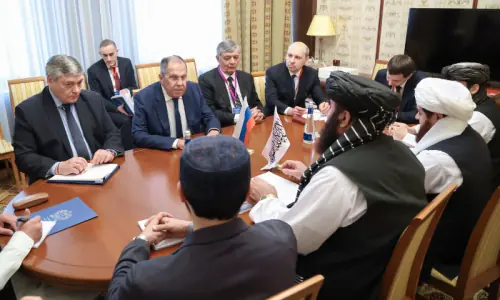
ISLAMABAD: Welcoming the initiation of Doha peace process, Jamiat Ulema-i-Islam (JUI-F) chief Maulana Fazlur Rehman on Wednesday reiterated his desire that the Pakistan government should also hold talks with Taliban to bring peace and stability in the region.
“The use of force does not work all the time and in all situations,” said the JUI-F chief while talking to a group of reporters after his meeting with a delegation headed by the Special Representative of United Nations (UN) Secretary General on Afghanistan Jan Kubis.
Answering a question, the JUI-F chief agreed that those who did not want to be part of the negotiations should be dealt with sternly, but at the same time called for finding out the forces obstructing talks when the national leadership had already decided and committed to holding talks with the Taliban.
He urged the international community and the US to pursue internal reconciliation to bring political stability in Afghanistan. “Internal reconciliation to bring political stability is much imperative so that after the withdrawal of the US in 2014, Afghanistan does not go back into civil war,” he added. When asked about his party’s alliance with the government, the JUI-F chief said the ruling Pakistan Muslim League-Nawaz (PML-N) was 100 per cent in agreement “with our priorities”.
“Joining cabinet seems to be the priority of some reporters, and not that of the JUI-F,” the Maulana said in a lighter tone in response to a question about the party’s plan to join the federal cabinet.
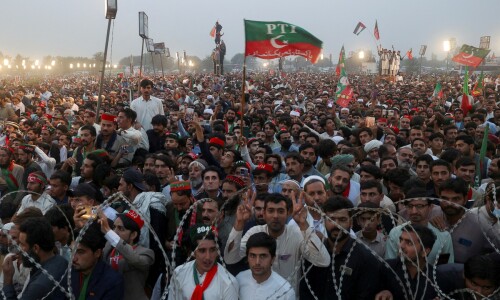
The Maulana criticised the PTI-led coalition government of Khyber Pakhtunkhwa, alleging that the provincial government had appointed 14 ministers, five advisers and five special assistants with ministerial status in violation of the 18th Constitution Amendment.
Earlier, the special UN representative on Afghanistan Jan Kubis met the JUI-F chief and apprised him of the UN’s efforts in the setting up of the Afghan Taliban’s office in Doha (Qatar).
A statement issued by Jan Achakzai, the spokesman for Maulana Fazlur Rehman, said the UN representative had linked peace in Pakistan with peace in Afghanistan.
Mr Kubis said the UN would continue to be engaged with Pakistan and other regional countries for a lasting solution for peace and stability in Afghanistan.
He also dispelled the impression that Pakistan was being bypassed. He said the UN supported a more stable, secure and prosperous future for the people of Pakistan.