0
0

“This is the heart of Taliban country,” said Azam Effendi, a retired brigadier who chose to stay in his ancestral village, Bagh Dheri, Swat, after retirement. “And yet I have no walls, no guards and no dogs.”
Effendi insisted this was the way to co-exist with your adversaries. But he did not say he was from the former royal family of Afghanistan, which gave him a certain advantage over others.
As he left after dinner, I sat there listening to the mountain night, bewitching and mysterious.
During the day the valleys echoed with election slogans. It was all so familiar; from Islamabad to Swat we saw dozens of rallies. Stopped for some. Ignored others.
Like in some other places in KPK and Northern Punjab, PML-N and PTI are the main contenders for two national assembly seats from Swat. PPP and ANP are a close third.
The rallies in Swat were as rowdy as those in other places. Slogan, pamphlets, posters and banners dominated all major streets and bazaars.
But the night was a different matter. The darkness reintroduced a sense of uncertainty to a land which only recently was run by the Taliban. The darkness increased during blackouts, now a common practice across Pakistan.
I could not figure out why I was uneasy but I was. Sitting quietly, I heard the wind hissing through the trees and orchards of Swat. Did I hear somebody groan?
Perhaps not but scared of my own imagination, I went inside. It was so comforting to sleep under the blankets when rest of the country was burning in summer heat.
In the morning, Effendi showed us bullet marks on his walls. Bigger holes were those of the shells fired during the 2009 military operation against the militants.
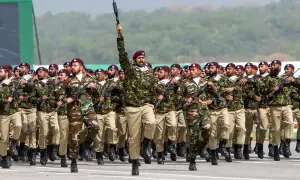
From Malakand to Bagh Dheri, we were stopped at more than a dozen military check posts, manned by soldiers in battle gear. Each time we entered a new town; we had to register at a military post and were checked out while leaving.
Despite the bullet marks and the check posts, the military presence is surprisingly popular in Swat. People acknowledge that the army helped restore stability to Swat and want the military to stay for as long as it takes to completely eradicate the threat of militancy.
I was surprised when an ANP supporter in Miandam town rejected the suggestion that the army had committed extrajudicial killings.
“It’s a war and those who fought the military were killed,” said Z. Khan, a school teacher.
But another ANP worker at a rally in Madiyan said he was not sure who brought the Taliban to Swat. “Perhaps, those who brought them are now fighting them.”
However, he also conceded that now the military should stay as long as was needed to defeat militants.
A government official overlooking the electoral process rejected the suggestion that the military may favor some candidates on the election day.
“So far, they have been completely neutral and I do not see how they can influence the voting,” he said. “I think the military wants to retain its neutrality.
In NA 30, Swat, Amir Maqam, a former PML-Q who is now in PML-N, has an edge over others but not because of his party. He is a leader of the powerful Gujjar fraternity and others also admire him because of his services to the community.
In NA 29, PML-N and PTI are engaged in a close fight while Jamaat-e-Islami is also in the game.
The Taliban’s exit from the scene has not weakened religious influence in Swat. The valley retains a strong adherence to Islam. Mosques are full at all five prayers.
But people do not respond positively when asked if they wanted Sharia.
“Swat is a part of Pakistan and it should follow the Pakistani constitution,” said Naseer Gul of Mingora. “In the name of Sharia, the Taliban imposed a very cruel system. We do not want that to be repeated.”
We met many who grew beards under the Taliban but were now clean shaven.
“If I want a beard, I will keep it. I do not want others to tell me what to do,” said Samad Khan of Mingora.
The media also has had its impact on Swat. People watch all major television channels and seem to have a clear opinion on all major issues.
“No more drones. I will vote for those who stop the drones,” said almost each of a dozen people interviewed in a Miandam hotel.
“We want someone who will end load shedding. We will not vote for those who make false claims,” said one.
“We want them to tell us how they will provide roti- kapra and makan to all. We need concrete plans, not mere promises,” said another.
All these were reassuringly familiar. So we went to bed, contended with the familiarity surrounding us.
In the morning we learned that ten gunmen were deployed around our hotel to make sure we were not kidnapped.