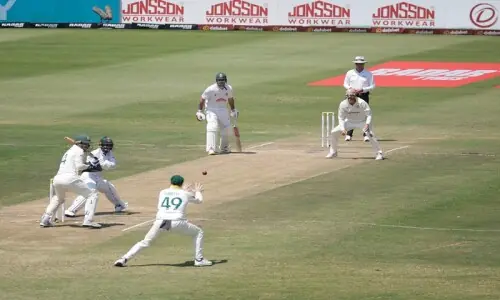
The first Ashes Test at Trent-Bridge which England eventually won by a close margin of 14 runs attracted a lot of criticism for the way Decision Review System (DRS) was implemented which led to some glaringly controversial decisions from the on-field umpires Aleem Dar, Kumara Dharmasena and the TV umpire Marais Ersamus of South Africa.
The ICC who introduced this system first in 2009 during a Test between New Zealand and Pakistan at the University Oval in Dunedin, for once, had to apologise for the failure of Hot-Spot feature which failed to pick up the ball’s contact with the bat when Jonathan Trott was given not out by Aleem Dar, a decision which was reversed by Erasmus and sent the unamused batsman back to the dressing room.
The decision by Aleem Dar to give Stuart Broad not out when he seemed to have been caught at the wicket was much debatable as was the decision of Ashton Agar given not out when he was stumped.
The ICC Chief Executive, however, came up immediately with a statement supporting the system and stressed that that the ICC will support and continue to work on the development of the technology.
"The trio did a good job under difficult conditions that reflects the calibre of Aleem Dar, Kumar Dharmasena and Marais Erasmus who have consistently performed at a high level,” said Richardson.
According to ICC assessment the umpires made seven errors during the first Test of which three were uncorrected decisions and four were corrected through DRS. The correct decisions percentage before review stood 90.3% but climbed to 95.8% as a result of the use of DRS — an increase of 5.5% correct decisions which was an average increase from DRS Test matches in 2012-13.
In support came out the MCC World Cricket Committee which only few days ago had met with men of the class of Mike Brearley, Majid Khan, Rodney Marsh, Barry Richards, Kumara Sangakkara, Steve Waugh and Michael Vaughan in attendance. Rahul Dravid and Anil Kumble had abstained understandably because of India’s refusal to use the DRS.
The committee supporting the system proposed to the ICC to own and implement the system universally — India included.
The DRS, the MCC committee restated, improves the quality of decision making. The consensus was that it is the poor implementation of the use of the system which is a worry and not the umpires.
The recent controversy in the series was well reviewed by the Times of India which in its columns wrote, “The argument put forth against the use of DRS in cricket was unwarranted. True the DRS did muck up one particular decision from the Test match but this was due to human operational error and not the technology itself. Hence to say that DRS should be scrapped altogether would be a case of throwing the baby out with the bath water.”
The purpose of introducing neutral umpires during the eighties and later the ICC elite panel followed by the use of technology in the game had come about because of constant complaints and bickering which marred Test matches and in which home bias was always mentioned by the losing teams.
Take away the facilities available now for decision making in the game and then you go back to zero and that could be a bigger worry than arguing about the disputed decisions through DRS.