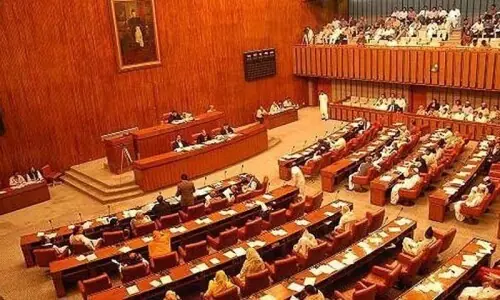
ISLAMABAD: The Council of Common Interests (CCI) on Wednesday approved the National Power Policy 2013 with the consensus of all the provinces.
The policy includes a raise in power tariff ranging from Rs3 to Rs7 for different categories of consumers.
The government's energy policy also approves the exploration of a ‘coal corridor’ with an estimated capacity of 7000 MW to generate cheaper electricity in order to meet the existing power crisis.
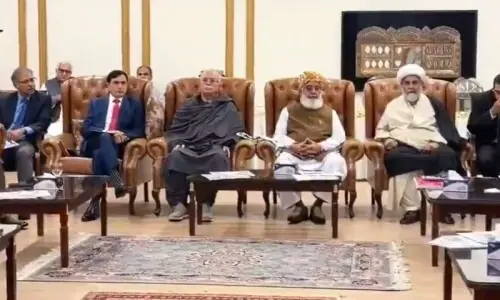
The council meeting, attended by Prime Minister Nawaz Sharif, the chief ministers of the four provinces and Water and Power Minister Khawaja Asif, also agreed to bring strict laws to curb gas and electricity pilferage.
Because of strong resistance put up by the Sindh, Balochistan and Khyber Pakhtunkhwa, a proposal for at-source deduction of electricity arrears from the provinces' share in the divisible pool was deferred.
Asif said the proposal would be taken up again about a month later.
The committee report also incorporated the Sindh Government’s demand for developing with the facilitation of the federal government ‘wind corridors’ to exploit wind resource in the coastal region of the province.
The technical committee also proposed ‘Integrated Utility Courts’ for dealing with electricity and gas thefts and rationalising the penalties for such crimes.
Both the proposals were approved by the CCI and made part of the National Power Policy.
Power tariff to be 'rationalised'
Later while unveiling the new power policy at a press conference, Federal Minister for Water and Power Khawaja Asif announced that the government would rationalise tariff for domestic consumers from October 1 and for commercial and industrial consumers from August 1.
The minister said new tariff for the consumers would be conveyed within days.
Asif said there would be no change in rate for first 200 units used by domestic consumers as an effort has been made not to put further burden on the poor.
He argued that change in tariff was unavoidable because not doing so would result in renewed accumulation of massive circular debt.
An official accompanying the minister said the average tariff for industrial consumers would go up to about Rs15 per unit from Rs9 and the average commercial tariff would rise up to Rs13.22.
The rate for bulk sales to residential colonies would be about Rs12 and average domestic rates would touch Rs15.50.
"The basic principle is to implement the minimum determined tariff of Nepra for each category to reduce a current gap of Rs5.81 per unit between the applicable and determined rates," he said.
The minister said the increase had been necessitated by a 13-14 month freeze on tariff imposed by the previous government. "Had the previous government gradually adjusted the tariff, the situation would have been much better and we would have paid Rs480 billion to retire circular debt."
Speaking about the new energy policy, Asif said the main thrust was to change the energy mix in the next three to five years by producing more affordable power from hydel and alternative sources and maintain tariff at a certain level.
He said the CCI had approved laws to increase punishment and fine for electricity and gas theft and to make them non-bailable and non-compoundable offences.
The minister added that steps were also under consideration to regulate the use of electricity in markets and business centers in evening.
He said 1100 megawatts could be saved by early closure of markets in evenings while 700-800 megawatts would be saved with the use of six million imported energy savers, which would arrive by September.