9
9


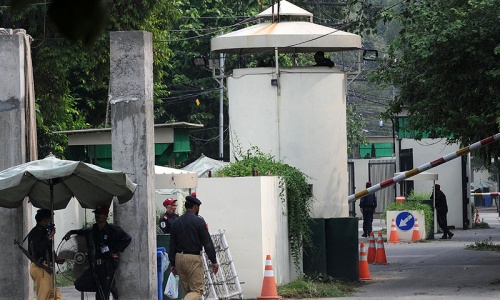
WASHINGTON: The US State Department spokeswoman Jen Psaki said Washington would keep its consulate in the Pakistani city of Lahore closed, after pulling out staff on Thursday due to a credible threat to the facility.
The United States said that it would reopen all of the embassies it shut this week except the one in Yemen and its consulate in Lahore, after re-assessing the Al Qaeda threat.
The United States had closed some two dozen embassies and consulates since August 4 after reported intelligence intercepts from Al Qaeda suggested an attack was imminent.
The closures affected virtually the entire Arab world and were eventually extended to include parts of sub-Saharan Africa.
Psaki said that 18 of the 19 embassies and consulates subject to the week-long closure would reopen on Sunday, a working day in most Muslim-majority countries.
“Our embassy in Sanaa, Yemen, will remain closed because of ongoing concerns about a threat stream indicating the potential for terrorist attacks emanating from Al Qaeda in the Arabian Peninsula,” Psaki said.
“Our consulate in Lahore, Pakistan, which closed due to a separate credible threat to that facility, will also remain closed,” she added.
Psaki said the United States would keep monitoring threats in Sanaa and Lahore as it decides when to reopen the missions.
President Barack Obama, speaking earlier Friday at a news conference, said that the United States was trying to strengthen countries' capacity to fight local branches of Al Qaeda.
“This tightly organised and relatively centralised Al Qaeda that attacked us on 9/11 has been broken apart,” Obama said. “And it is very weak and does not have a lot of operational capacity.”
But Obama pointed to dangers of Al Qaeda in the Arabian Peninsula, a unit of the extremist group that effectively controls parts of Yemen.
“We still have these regional organizations like AQAP that can pose a threat,” he said.
Obama met last week at the White House with Yemeni President Abdrabuh Mansur Hadi and praised him for his cooperation with the United States against Al Qaeda.
At least 12 suspected AQAP militants were killed in three separate drone strikes in Yemen on Thursday.
The Wall Street Journal cited an anonymous US official as saying the leader of AQAP, Nasser al-Wuhayshi, masterminded a plot that sparked the global alert.
The Obama administration chose to close the embassies after facing criticism at home over the deaths of four diplomats, including ambassador Chris Stevens, in an attack by extremists on the US consulate in Benghazi, Libya.
The threat was also reported at a time when many US lawmakers are questioning the need for pervasive government surveillance on its citizens' communications.
Obama called his news conference on Friday to announce reforms to increase the transparency of intelligence operations.