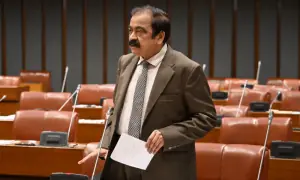
ISLAMABAD, Sept 11: Minister for Information and Broadcasting Senator Pervez Rasheed on Wednesday said media had not played its due role in raising awareness of counterfeit, fake and infringed products.
“Media can play pivotal role in raising awareness of the menace of counterfeiting and piracy affecting the rights of consumers and investors,” the minister said, adding that the intellectual property right is key to success of any business.
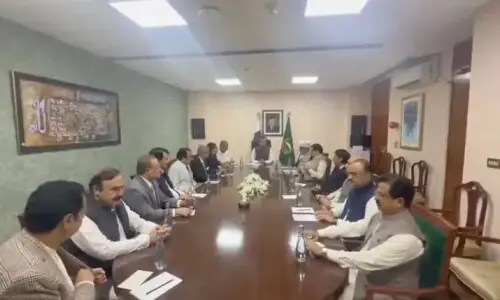
Senator Rasheed was addressing a workshop ‘Role of media in projecting legitimate business practices and curbing piracy’ here on Wednesday.
The workshop was organised by Anti Counterfeit and Infringement Forum (ACIF) a group of multinational and local corporates, who have been hit by locally manufactured fake or counterfeited smuggled products.
The minister assured that measures should be taken to protect Intellectual Property Rights (IPR) of a person and implementation of Intellectual property laws is crucial for economy, businesses and consumers protection in the country.
The minister said that public and private sector should come closer and share their opinion and expertise to devise means required to curb the evils of counterfeiting, piracy and smuggling.
“Counterfeiting, piracy, substandard production and smuggling are barriers to innovation and economic progress of a country, causing losses worth billions of rupees to the national exchequer on the account of tax evasion,” he added.
However, neither the minister nor the officials concerned provided any future course of action and roadmap to counter open sale of pirated products in the country.
Deputy Director General, Intellectual Property Organisation– Pakistan (IPO- Pakistan), Mohammad Ismail in his presentation said that 60 per cent of the consumer goods in the country were pirated or substandard.
“Some accounts suggest that piracy in Pakistan has been recorded at 86 percent, while it is 20-35 per cent in developed countries,” Mr Ismail added.
Though, he acknowledged that the relevant law was in place in the country through the IPOP Act, 2012, but did not specify any further step taken by the authorities to implement the IPO laws in Pakistan.
The Deputy DG only said: “IPO is committed to supporting efforts in creating an environment conducive to IP protection.”
It was highlighted that media has an important role to create awareness by highlighting socio-economic issues arising out IP- rights violations.
The participants were informed that IP rights were close to the consumer rights and both are being openly violated in Pakistan, as the consumers pay for a branded product but at times they get a low quality counterfeit product at the same price.
This was a loss to both the company that had developed trust among the customers and the consumers who were paying higher price.
IPR issue is also very sensitive for foreign companies who plan to enter Pakistani markets but the widespread violation of IPR laws and inefficiency of the government agencies to control it have made them reluctant to make investments in the country.
Ameena Saiyid, Chairperson ACIF, and Managing Director, Oxford University Press, pointed out that Pakistan is one of those countries where violation of IPRs is rampant, adding that protection of IPRs promote genuine business practices.
She suggested that the there is a need to further strengthen IPRs law, a help line must be setup to register compliant against counterfeiting and piracy and investigation cell to be setup to investigate people violating IPRs laws.
“The hallmarks of a progressive society are the protection of rights of creators, artists, writers and investors in fostering creativity and innovation,” she added.
Apart from the publishers, the tobacco industry was also at the forefront against piracy, counterfeit and smuggling of product in country as it was hitting their market share.
Hassan Khawar, Head of Business Development Group, Pakistan Tobacco Company (PTC) said that the estimated loss to the government from the illicit cigarette trade has been over Rs80 billion in the last five years and would increase to Rs100 billion in the next five years, if it continues the same way.