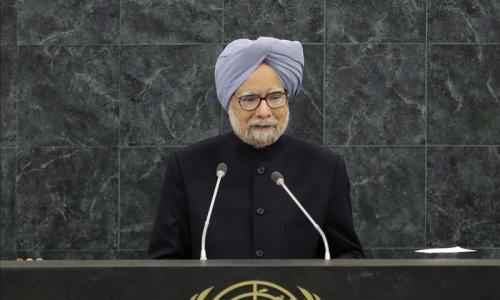
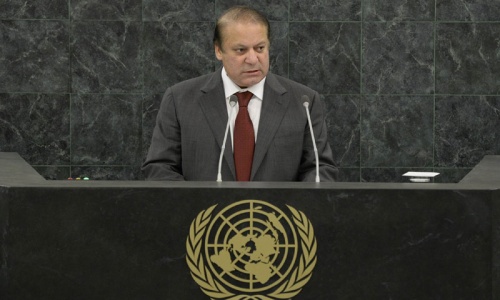
NEW YORK: Indian and Pakistani prime ministers will meet in New York in the next few hours but neither side expects a major breakthrough from these talks.
“The expectations are so low that a no-failure will look like a success,” said a senior Indian official when asked to define what India expects from the talks.
Talking to a group of Indian journalists at a New York hotel, the official said the Indians also felt that Prime Minister Nawaz Sharif did “not have full control” over the security apparatus of his country while most of India’s concerns, he added, revolved around security.
Indian Foreign Minister Salman Khurshid also made this point in an interview he gave to a group of Pakistani journalists. He complained that while seeking friendship with India, the Pakistanis also “kept spitting on our faces.”
Despite these low expectations, the meeting has its own significance as this will be the first summit-level talks between the two countries in more than three years.
Yet, both sides seemed focused more on domestic political gains than promoting bilateral ties.
A closer look at the statements coming from the two sides shows that the Pakistanis will be happy to present the holding of talks as a success in itself.
They feel that the meeting with the Indian prime minister can be interpreted in Pakistan as Mr Sharif’s first success in fulfilling his election pledge of working to improve ties with India.
The Indian expectations are a little higher.
They expect a pledge from Pakistan that it would not allow its territory to be used for terrorist attacks inside India.
Such a statement can help the ruling Congress Party boost its political fortunes. It can also help them refute the opposition’s claim that Mr Singh has betrayed India by meeting the Pakistani prime minister despite alleged cross-border terrorist attacks.
And from the very beginning, both sides have used public statements to set the agenda.
In all his statements, Mr Sharif stressed the importance of making “a new beginning” and resuming the stalled talks, telling the Indians that more concrete steps could follow.
But Prime Minister Manmohan Singh and his aides played down this point, telling Pakistanis that they were more interested in practical steps than just the atmospherics.
Mr Sharif also used his address to the UN General Assembly on Friday for telling the Indians to “make a new beginning” by holding the talks.
He said that if they took the initial steps now, both countries could reap the benefits later, such as saving money from their defence budget to spend on social projects.
“Our two countries have wasted massive resources in an arms race,” he said. “We could have used those resources for the economic well-being of our people.”
This, however, is more of a concern for Pakistan because of its weaker economy. The Indians feel that their economy is strong enough to allow them to afford a steady increase in their defence budget.
Mr Singh has been focusing on issues important for him and his party’s political campaign for the next year’s elections.
In his address to the UN General Assembly on Saturday, he warned that Pakistan must stop being “the epicenter of terrorism” if it wants better ties with India.
“For progress to be made, it is imperative that the territory of Pakistan and the areas under its control are not utilised for aiding or abetting terrorism,” he said.
“It is equally important that the terrorist machinery that draws its sustenance from Pakistan be shut down,” he said.
Mr Singh said he supported resolving questions over Kashmir but stood firm that the Himalayan territory was “an integral part of India.”
“There can never, ever, be a compromise with the unity and territorial integrity of India,” he said.
“Such rhetoric is useful for making political points at home, not for improving ties with a neighbour,” said a diplomatic observer when asked to comment on Mr Singh’s statement.
Other observers pointed out that it was a mistake to hold the talks at a stage when one government – that of Mr Sharif – was still settling in while the other was going to elections.
“This is a meeting between a spring chicken and lame-duck,” said an observer. “Both would have benefitted from holding it later.”