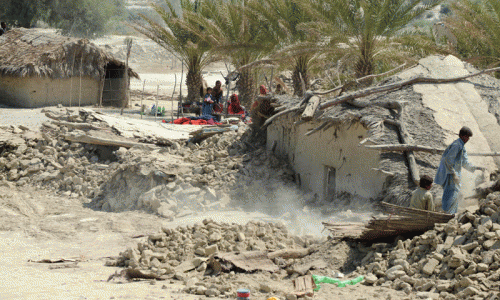
AWARAN: The only thing that has changed in the dusty town of Awaran in the past two weeks is that it looks more and more like a militarised zone, with a major relief operation under way.
Awaran’s moment came in the form of a disaster, with millions of Pakistanis hearing the name of the backward district in Balochistan for the first time.
Men and women coming from far-flung areas to the sparsely furnished and ill-equipped District Headquarters Hospital in Awaran complain of not getting relief goods at all. Others accuse politicians of being complicit in crime. Many others have worse stories to share.
A man from Tertij, who has been coming to the DHQ Hospital everyday with an ailing elder suffering from gastroenteritis, says he was barred from getting relief goods.
“At this point, politics should be kept aside. I need food for my children and that is why I was willing to accept the relief goods. But then we were threatened. I don’t know what to do,” he said, his voice filled with anger.
He accused the government of not doing anything. “After 60 years they realise that we exist and not just on paper.”
Others in the hospital’s OPD have similar complaints and say they have moved to Awaran temporarily so that they can receive some aid.
A woman at the medical facility rolled up her sleeves to show bruises. “The men from our family are in Muscat. The quake damaged our homes. The army trucks came to our village but we were barred from receiving anything.”
She says that when she insisted people to be allowed to receive food and tents, she was beaten up to serve as a lesson.
More aid required
While the locals are tightlipped about naming anyone, journalists in the area are quite forthcoming.
At the Awaran Press Club on Tuesday, its President Mohammad Ramzan and General Secretary Shabbir Rakhshani stressed that delivering aid remained a complex situation.
“Aid is coming in but is either not reaching its destination or is being refused and destroyed,” they said. “We are not satisfied with the relief work. Distribution is being done on political basis,” according to Ramzan. “There is a strong need for trans-parency and long-term rehabilitation,” he said and stressed that the local administration must wake up and do its job.
The relief update shared by the NDMA on Tuesday states that 42,690 tents have reached the area and have been distributed. Furthermore, 53,856 ton of food ration packs and 50 ton of high energy biscuits have been given away at relief camps and through airdrops. While the figures are impressive, it will take a long time before the survivors get back on their feet.
There has also been criticism of the government for not allowing foreign aid agencies and donors to work in the area.
Talking to Dawn, Hussain Ullah, a representative of UN Office for the Coordination of Humanitarian Affairs (OCHA), said: “We offered cooperation to the government in carrying out a joint assessment and mobilising resources but the request was turned down.”
When asked if the figures coming out of the area were accurate, he said: “In most parts of Pakistan where disasters took place, we had some on-ground presence because various United Nations agencies work with the government and NGOs. However, in the district of Awaran, we have no presence.”
“We reiterate our stand and anytime the government of Pakistan sends in a formal request, we are willing to assist them.”
Patience running thin
On the other hand, patience is running out for those delivering aid. A volunteer with a medical association said that people refused to take medicines from Pashtuns or Punjabis.
“We are to do a job which is to help people. It is disappointing that the locals curse us and have gone to the extent of pelting us with stones,” a jittery paramedic said.
The situation of the jawans is no different. While they have been trained to ‘serve the nation’, they say their patience is running thin because of unprovoked attacks from nearby mountains.
Meanwhile, senior army officials say they are exercising maximum restraint and will not use the relief as a cover for an operation.
Only a day earlier, at a relief camp set up in the middle school in Labach, a village some six km from Awaran, the villagers accepted food packs and toys for their children. However, the 600-strong crowd of men, women and children did not respond to an army jawan’s repeated ‘Pakistan Zindabad’ slogan.
When asked why not even a single person responded to Pakistan Zindabad, a young Baloch man replied: “The armymen will leave at some point but we have to continue to live here. The BLF men will harm us.”
When prodded further as to how the BLF men will find out who chanted Pakistan Zindabad, the young man said: “In this crowd, there are BLF supporters and their families too. Do you think their families are getting aid from the mountains?”