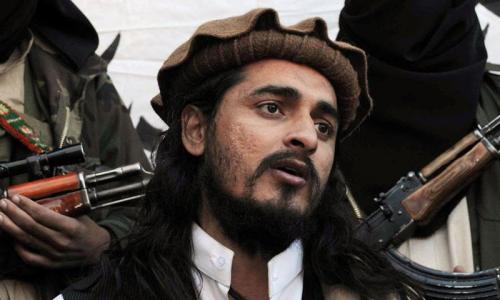
Mullah Fazlullah, the new leader of the Pakistani Taliban, has a reputation as a ruthless commander prepared to do anything to enforce his uncompromising interpretation of Islamic law.
He has succeeded Hakimullah Mehsud, who was killed in a US drone strike in North Waziristan last week.
He led the Taliban's brutal two-year rule in Pakistan's northwest valley of Swat, which saw supposed wrongdoers flogged and beheaded in public and hundreds of schools burned down.
Under Fazlullah's rule, Green Square in Mingora, the main town of Swat, became known as “Bloody Square” for the slaughtered, bullet-ridden bodies that were hung in it almost every day.
Fazlullah, believed to be aged 39, was born Fazal Hayat in Swat. He studied at an Islamic religious school and worked as a chairlift operator and sold firewood, before joining his father-in-law's Tehrik Nifaz-i-Shariat-i-Muhammadi (TNSM), or Movement for the Enforcement of the Sharia of Muhammad (pbuh).
After US-led forces entered Afghanistan to oust the Afghan Taliban from power in 2001, Fazlullah joined thousands of Pakistanis who crossed the border to fight what they saw as a “holy war” against the invaders.
He was arrested on his way back to Pakistan but was later released on bail and became the head of the Sharia movement in Swat after his father-in-law was jailed.
In 2006 he began delivering fiery sermons on his own FM station, earning the nickname “Mullah Radio,” railing against polio vaccination programmes and girls' education.
After a deadly army operation to clear the radical Lal Masjid (Red Mosque) in Islamabad, Fazlullah merged his TNSM with the newly formed Tehrik-i-Taliban Pakistan (TTP).
As his control of Swat, once a popular tourist destination known as the “Switzerland of Pakistan,” grew from 2007 onwards, Fazlullah set up Sharia courts that handed out savage punishments.
In 2009 Malala Yousafzai, aged just 11, began a blog on the BBC Urdu website chronicling the horrors of life under the Taliban.
The TTP made an unsuccessful attempt to kill her in Swat in October last year, saying she had campaigned against them. She survived being shot in the head and has gone on to become a global icon of the struggle against extremism.
An army offensive ended Fazlullah's rule in Swat in 2009 and he escaped with a band of loyalists into the mountains of eastern Afghanistan, from where they have continued to orchestrate attacks in Pakistan.
Fazlullah, who has a $500,000 government bounty on his head, has mounted some brutal and humiliating attacks on Pakistan's military, including the beheading of 17 soldiers after an attack in June 2012.
In September, soon after Pakistan's political parties had backed a government plan for peace talks with the Taliban, Fazlullah's men responded with violence.
A bomb attack killed two senior army officers, including a major general, in the country's northwest, a galling blow for the military.
Fazlullah claimed the attack in a video message in which he spelled out his hardline position.
“We will remove any hurdle to enforcing Islamic Sharia. Our goal is very clear – we want the law of Allah in Allah's land,” he said.