ISLAMABAD: The Pakistan Tehrik-i-Insaf (PTI) claimed a “tactical success” Wednesday after the US military suspended shipments of equipment out of Afghanistan via a key Pakistani route, citing protests that posed a risk to truck drivers.
Activists in the northwestern Khyber Pakhtunkhwa province, some armed with clubs, have been forcibly searching trucks in an effort to halt Nato supplies in protest over US drone strikes in Pakistan's tribal belt.
The unofficial checkpoints began on November 24 after a call to blockade Nato supplies by Imran Khan, the head of the PTI which leads the KP provincial government.
Pentagon spokesman Mark Wright said on Tuesday that the US had “voluntarily halted” shipments of cargo leaving Afghanistan through the Torkham border crossing in Khyber Pakhtunkhwa.
“We have voluntarily halted US shipments of retrograde cargo through the Pakistan Ground Line of Communication (GLOCC) from Torkham Gate through Karachi,” Wright said in a statement.
Torkham is a key transit point used by the Americans and Nato to withdraw military hardware from Afghanistan, as part of a troop pullout set to wrap up by the end of 2014.
Another border crossing point for Nato convoys in southwestern Balochistan province is not subject to the PTI-led protests, and convoys there are understood to be unaffected by the suspension.
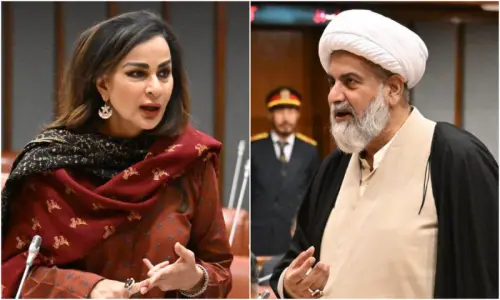
PTI spokeswoman Shireen Mazari hailed the Pentagon's move as a “tactical success” and said the protests would continue.
“The US decision to halt Nato supplies through Torkham doesn't affect our protest and we will continue our protest until drone strikes are stopped,” she told news agency AFP.
Khan demanded the government block Nato supplies after a US drone strike that killed Pakistani Taliban leader Hakimullah Mehsud but Islamabad has shown no appetite for such a move.
US officials said trucks have been told to wait for now in holding areas in Afghanistan, with Washington expecting the route to resume operating soon.
“We anticipate that we will be able to resume our shipments through this route in the near future,” Wright said.
A US defence official said Washington believed the Islamabad government fully supported the use of the route and that it would soon restore security to the area.
Islamabad signed a deal with the US in July last year allowing Nato convoys to transit Pakistan until the end of 2015, but a spokesman for the interior ministry said they were unable to intervene.
“Maintaining law and order is a provincial subject and the provincial government is responsible for security of Nato trucks, we can't direct them in this regard,” Omer Hameed Khan told AFP. The PTI leads the government in Khyber Pakhtunkhwa province, but highways come under the authority of the federal government, and some have argued there is no legal basis for the blockade.
Alternative routes
The United States has alternative routes available to Afghanistan's north through Central Asia, though those options take longer and are more expensive.
“While we favor shipping cargo via Pakistan because of cost, we have built flexibility and redundancy into our overall system of air, sea and ground routes to transport cargo into and out of Afghanistan,” Wright said.
The US and Pakistani governments recently issued a joint statement saying the road route through Pakistan was considered important to both of them, as well as to the Nato alliance.
About half of US cargo is being taken out through Pakistan, with the remainder being removed by aircraft or a combination of planes and then ships at regional ports.
Nato cargo shipments across Pakistan have been disrupted in the past due to political strains.
Islamabad shut its border to coalition trucks for more than seven months after a US helicopter killed 24 Pakistani troops, reopening it in July 2012 after Washington apologised.
As of September, the Pentagon said it had to send home 24,000 vehicles and 20,000 shipping containers of equipment after more than 12 years of war.
The whole withdrawal will cost an estimated $7 billion, according to Pentagon officials.
Civilian deaths from America's covert drone operation have also proved contentious in Afghanistan, where President Hamid Karzai has demanded an end to civilian casualties before he agrees to sign a proposed 10-year security agreement with the United States.