94
94

ISLAMABAD: Federal Secretary of Water and Power Younus Dagha on Sunday claimed the country-wide power breakdown was caused by militants who had blown up two transmission towers in Balochistan.
“Two transmission towers were blown up by miscreants in Sibi late on Saturday,” Dagha said.
Early on Sunday, Pakistan had been plunged into darkness after a key power transmission line broke down. The power failure, one of the worst the country has experienced, caused electricity to be cut in major cities, including the capital Islamabad.
This was the fourth major breakdown of the system within the past one month plunging countless cities, towns and villages in Punjab, Khyber Pakhtunkhwa and Balochistan into darkness. A substantial area in Sindh was affected, too.
The federal secretary said over 7,000MW of power had been restored and further work was underway to end the breakdown, which still extended into parts of Pakistan. He said the country was currently facing 4,000MW power shortage, and it was expected that the situation would normalise tomorrow (Monday).
Addressing a press conference in Islamabad, Dagha admitted there had been a security lapse. He did however argue that it was impossible for the state to monitor transmission lines spread over thousands of kilometers.
Dagha said it was time consuming to restore technical problems in the system as there was a single national grid station to supply power. He said steps were being taken to establish at least two alternate grid stations in the country.
Clarifying rumours about an acute shortage of furnace oil, Dagha claimed an additional six days of stock was present and there was no fear of any power crisis at present.
Read: Parts of Pakistan still without electricity, following breakdown
Gridlocked – how power is lost
 |
| Complied from media reports |
 |
| Compiled from Hydro Potential in Pakistan, Pakistan Water and Power Development Authority, November 2011 |
 |
| Compiled from Nepra’s State of Industry Report, 2012 |
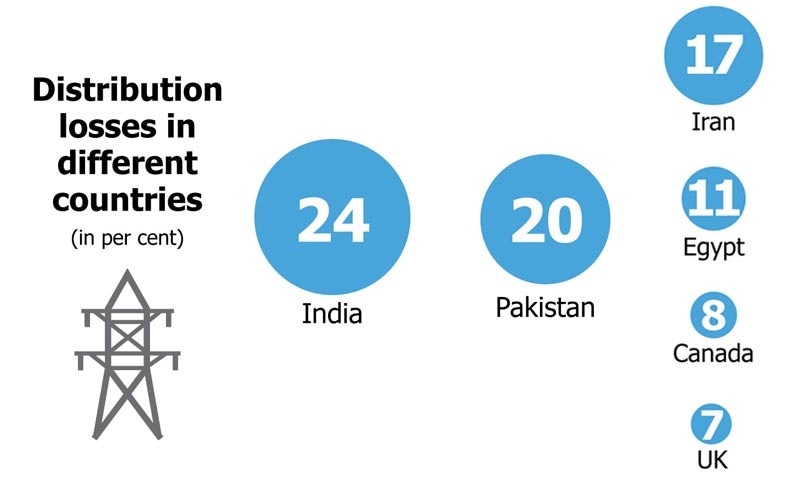 |
| Compiled from The World Bank’s, World Development Indicators Report, 2012 |
 |
| Complied from Pakistan Economic Survey 2013-2014 |