2
2
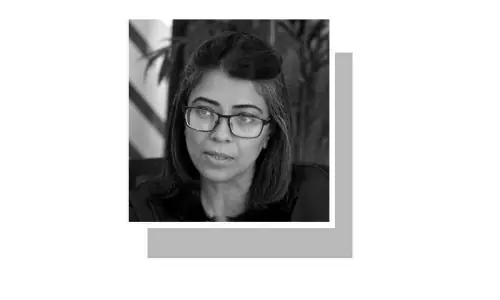
KARACHI: The kind of discourse surrounding gender and space is quite discomforting. There’s a falsity in the discourse when one hears people speak about bringing women to the public space. Women, be it from any class or caste, have always occupied public spaces, writer and documentary film-maker Promita Vohra said after the screening of her documentary on public toilets at The Second Floor on Sunday.
Throughout the 55-minute documentary, Q2P (Queue to Pee), Vohra shows the dichotomy found in most mega cities of South Asia. The dichotomy is based on people coming together with a common dream of surviving in a mega city while just as easily being separated on the basis of caste, class, religion and gender.
Introducing Vohra, an award-winning documentary film-maker from India, moderator Naila Mahmood said the screening is part of a four-day workshop ‘The City in South Asia’ being held in Karachi. It focuses on the lives of the marginalised and how they survive in the continually expanding cities in South Asia.
Speaking about her film which she made in 2007, Vohra said: “There is a silence that surrounds a discussion on public toilets, just as there is a silence that surrounds a discussion on equality. Both are riddled with many answers about caste, race, class and ethnicity.”
The film begins with a long queue of men standing outside a women’s toilet. While searching for a women’s toilet, Vohra comes across a few men standing outside a loo near the Dadri station, Mumbai, and asks them why a washroom for women is built far away while the men’s toilet is built right next to the station? A man gives a perplexing reply: “Women need a lot of space, while men can stand anywhere and nobody would know what they are up to.” In another shot, women are shown paying a rupee to use the washroom while men use it for free. Explaining this, an official from the municipal corporation of Mumbai tells Vohra, “Men can’t be asked to pay because they need to urinate a lot. But women need to specify why they are using the loo. That way they won’t be asked to pay.”
Throughout the documentary, Vohra takes her viewers to various urinals across Mumbai and Delhi and makes insightful observations. For instance, in a Muslim neighbourhood a urinal has been built in the direction of the Kaaba. Young girls working at a grooming centre say they don’t use public toilets and have learnt to “control the system”. A teacher at a municipal school in Mumbai says that up until the primary class girls regularly use toilets. “But once they start menstruating, they stop. Most don’t drink water to avoid going to the loo. As a result, many complain of tummy aches.”
Vohra also speaks to Sheikh Razzak, who builds toilets for those living inside slums. He says he builds them by digging 6x6 holes in the ground. “It is illegal, but it is the only way.”
“My tone would be more critical if I were to make the film today. There are many attitudinal issues related to for instance the ‘Swachh Bharat’ campaign initiated by the PM. It doesn’t take into account what people in rural areas want. The truth is private spaces are not spoken about as much as they should,” Vohra said.
Published in Dawn, January 4th, 2016