47
47
Foreign Secretary Aizaz Ahmad Chaudhry said India's violation of the Indus Waters Treaty (IWT) would set a dangerous precedent for other countries to behave similarly, but remained hopeful that India would refrain from such actions.
"Contravention of the treaty or its unilateral abrogation by India will not only violate the IWT, but also set a precedent providing other countries a possible justification to undertake similar actions," Chaudhry said while speaking to Russian news agency Sputnik.
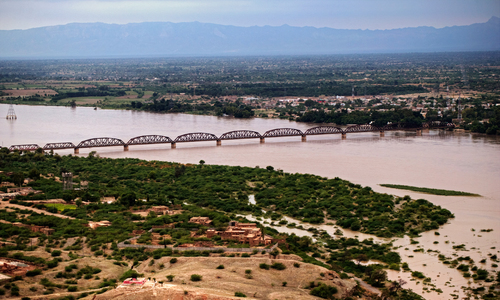
The IWT was signed in 1960 and allocated the three eastern rivers of the Indus basin — the Ravi, Beas and Sutlej — to India, while 80 per cent of the three western ones — the Indus, Jhelum and Chenab — were allotted to Pakistan.
It was reported earlier this week that India is stepping up efforts to maximise its use of the western rivers of the Indus basin, a move that involves building large storage facilities and canals.
India has maintained that it has not fully utilised its 20pc share of the Indus waters and that the proposed water projects would not be in violation of the treaty. Pakistan has disputed these claims.
Chaudhry said that issues such as extremism have damaged the relationship between India and Pakistan. He reiterated the need for both countries to hold bilateral talks focused on these important issues.
“Relations between Pakistan and India have not been very good and the reason is that Pakistan and India are not having any dialogue," he said.
He added that lack of such dialogue had allowed the relationship between the two countries to deteriorate.
"We also believe that it is for the [best for] our two counties to sit at the table and share each other's perspectives,” Chaudhry said.
However, he added that the Shanghai Cooperation Organization (SCO), a group dominated by Russia and China, was not the correct platform to hold bilateral dialogue.
Pakistan and India's full membership to the powerful SCO was approved by its Council of Heads of State at its 15th Summit last year. In July, Pakistan signed the Memorandum of Obligations (MoO) with the objective of obtaining full membership of the organisation.
Chaudhry described the SCO as "a good forum to work for maintenance of regional peace, security and stability, economy and trade."
UN's role in Kashmir
Chaudhry said the role of the UN Monitoring Observer Group in India and Pakistan was critical to peace between Pakistan and India.
"The Group can also independently monitor ceasefire violations," Chaudhry said, alleging that India had violated the ceasefire agreement 310 times since September.
He said the international community, too, should play its role in ensuring that India respects its international obligations and commitments.