Protests rage in northeast India over citizenship bill



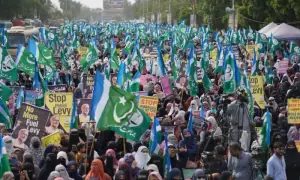
GUWAHATI: Protesters in northeast India set fire to tyres and cut down trees to block roads on Tuesday in a shutdown across the region hours after lawmakers approved the government’s new citizenship bill.
Prime Minister Imran Khan also condemned the passing of the Citizenship Amendment Bill by Indian Lok Sabha, saying the legislation is a violation of international human rights law and bilateral agreements with Pakistan.
The legislation, set to go before the upper house on Wednesday, will fast-track citizenship claims from immigrants from three neighbouring countries — but not if they are Muslim.
For Islamic groups, the opposition, rights groups and others, this fits into Prime Minister Narendra Modi’s Hindu nationalist agenda to marginalise India’s 200 million Muslims — something he denies.
People in northeast India object for different reasons, fearing that large numbers of Hindu migrants from Bangladesh, who they say are intruders, will swamp their homeland.
Imran says legislation is violation of international human rights law and bilateral agreements with Pakistan
On Tuesday the region — that is sandwiched between Bangladesh, China and Myanmar — was crippled by a general strike called by dozens of organisations, with buses off the roads and most schools and shops shut.
“The bandh (strike) has drawn a total response in the northeastern states,” said Samujjal Bhattacharyya from the powerful umbrella group the North East Students’ Organisation.
“We have made it clear ... that CAB (the Citizenship Amendment Bill) will not be accepted and we are going to intensify our agitation,” he told AFP.
“Assam and northeastern states had already taken a huge burden of illegal foreigners,” he said.
India’s lower house passed the bill just after midnight following a fiery debate that saw one Muslim MP compared the government to the Nazis.
Once law, it will make it much easier for Hindus, Sikhs, Buddhists, Jains, Parsis, and Christians fleeing Afghanistan, Bangladesh and Pakistan to become Indians.
The move evoked sharp reactions from international groups, with an influential US body calling for sanctions on Mr Shah and other key players of the proposed law.
The US Commission on International Religious Freedom in a statement on Monday termed the bill as a “dangerous turn in the wrong direction”, that together with the proposed National Register of Citizens, aims to create a religious test for Indian citizenship that would strip citizenship from millions of Muslims.
India’s foreign ministry on Tuesday retorted, saying the US group’s remarks were “neither accurate nor warranted” and “guided by their prejudices and biases”.
The European Union’s ambassador to India Ugo Astuto also expressed the bloc’s concerns, saying he hoped “the principle of equality enshrined in the Indian Constitution will be upheld”.
Design of expansionism
“It is part of the RSS Hindu Rashtra design of expansionism propagated by the fascist Modi government,” PM Khan wrote in a tweet, coinciding with his message on International Human Rights Day.
On situation in India-held Kashmir, the prime minister said “we must appeal to the world’s conscience, to upholders of international law and to the UNSC to act against the illegal annexation of IOJK”.
“We condemn the occupying Indian government’s siege of IOJ&K ongoing for over four months now and demand an end to the gross abuse and atrocities being inflicted on Kashmiri men, women and children by Indian occupation forces in violation of all international humanitarian and human rights laws,” he said.
Mr Khan said: “We salute and stand resolutely with the brave Kashmiris struggling for their right to self-determination.”
Earlier, the Foreign Office in a statement termed India’s Citizenship Amendment Bill “another major step towards the realisation of the concept of Hindu Rashtra, idealised and relentlessly pursued by the right-wing Hindu leaders for several decades.”
“It is driven by a toxic mix of an extremist Hindutva ideology and hegemonic ambitions in the region. It is also a clear manifestation of interference in the internal matters of neighbouring countries based on religion, which we reject completely,” added the statement.
Published in Dawn, December 11th, 2019