0
0

WHEN is a state deemed to be a failed state? When it is bankrupt, or when its laws are largely ignored? Pakistan has been on the verge of bankruptcy several times in its brief history, but external aid has kept it out of debtors prison.
The last major fiscal crisis was averted by the events of 9/11, and our promotion overnight to frontline status in the war on terror. Indeed, our exchequer has never been as healthy as today, thanks to a steady stream of dollars from Western allies concerned about Pakistans possible insolvency and its effect on the campaign against terrorism.
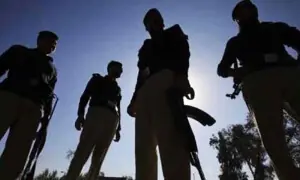
But our new friends would do well to consider the destabilizing impact of Pakistans slide into anarchy. Before I am accused of overstating the problem, let me point towards the current ongoing insurgencies in Balochistan and South Waziristan. Both conflicts underline the fragility of the Pakistani state even 58 years after its creation.
At Partition, the tribal areas of the NWFP and Balochistan were some of the most backward parts of the subcontinent. Nearly six decades later, nothing much has changed. The ruling sardars may be driving around in luxurious SUVs; the houses may have sprouted TV dish antennas; and tribesmen may be carrying automatic Kalashnikov assault rifles instead of ancient Lee Enfield 303s. But women are still not allowed to leave their homes even to vote; girls are not sent to schools; and the only law is laid down by the tribal chief.
As a result, these areas have not emerged from the dark ages, and are a haven for drug smugglers, gun runners, kidnappers, Taliban fighters and Al Qaeda terrorists. Following colonial policy established in the 19th century, successive Pakistani governments have bribed tribal chiefs to keep the peace without bringing development to most of this benighted belt.
After all, if the law of the land does not extend to these parts, how do you build roads, schools and hospitals? More to the point, who will invest in industry if capital is not protected by the laws and institutions of the state? Without this normal developmental and business activity, it is no surprise that these are some of the poorest areas in the country.
Of course, this wild and woolly frontier mentality has produced many opportunities for tribal chiefs to become very, very rich. Not only do they get state subsidies, but the government does not interfere with their wide range of illegal operations. They shelter all kinds of crooks, getting a percentage of the spoils: whether it’s a stolen car the police from ‘settled areas’ can’t follow into the tribal belt, to a kidnap victim who is housed until a ransom is negotiated. Illegal narcotics and the most sophisticated arms are transported freely, winding up in the hands of killers and terrorists across the country.
The argument against extending the writ of the state to these chaotic badlands is that things are not much better in the rest of the country. This assertion is not supported by the facts on the ground. The reality is that much of what today constitutes Pakistan was the backwaters of undivided India. And yet, schools, colleges, universities, roads, dams and much else have been built over the years. Industries have sprung up. Business has grown steadily. And although the law and order situation obviously leaves much to be desired, there is still a minimal deterrence in place.
Clearly, the existence of large pockets of lawless lands whose autonomy is guaranteed by the Constitution has helped in the spread of anarchy in the country. Since the Afghan war, guns and drugs have flooded the country from the tribal belt. The current resistance to the government in South Waziristan and parts of Balochistan illustrates the point: the rebels have used missiles, anti-aircraft weapons and an array of modern and very lethal arms. In fact, the army has suffered serious casualties in its operations, and is now using helicopter gunships to quell the rebellion.
Over the years, the perception that they are being exploited has steadily grown among many Baloch. There is no doubt that the province is not adequately recompensed for its natural gas that has been crucial to the country’s development. But the problem is that the present tribal system does not allow money to go to the people as most of it is siphoned off by the tribal sardars. So even if a more equitable sum is allocated, how do we ensure that it reaches those who need it most?
Clearly, the time has come to review the constitutional provisions that govern this anachronistic arrangement. Any government has a duty to ensure that the underprivileged are cared for at a certain minimal level. In our tribal areas, men have decreed that women cannot be educated; cannot leave their homes; and cannot vote. This repression is being carried out in the name of ‘tribal traditions’ as well as religion. But surely the same laws ought to protect women all over the country. Granted, women are not exactly emancipated in much of Pakistan. But at least they have courts to appeal to, at least in theory. No such legal protection exists for their sisters in the tribal areas.
We Pakistanis are a very contentious lot: witness the heated debate taking place over the issue of the controversial Kalabagh. But oddly, there has been virtually no discussion over the anomaly of the whole sardari system that denies millions the rights due to them as citizens of Pakistan. Some see this as a romantic vestige of the past: brave tribal figures resisting the encroachment of modern influence. But this archaic set-up denies millions access to education and basic health facilities. It also blocks employment opportunities, forcing young men to leave their homes to find jobs far away from their villages.
So when Baloch nawabs demand a greater share of national resources, we should remember that they are demanding more for themselves, not their people. The poor tribesmen fighting and dying in the name of Baloch autonomy are not doing so to make their families better off. They are acting on the command of their tribal chiefs.
It is high time that we looked carefully at what this entire system has done not just to the tribesmen directly affected, but to the whole country. Just because it suited the British to have a buffer zone along the Afghan border does not mean we must continue this outdated arrangement.