Govt won’t let country’s stability be derailed: Imran

ISLAMABAD: Amid reported unease between the military and the judiciary over the “controversial” verdict by a special court ordering public hanging of former president retired Gen Pervez Musharraf’s body for three days, Prime Minister Imran Khan on Friday said his government would never let the stability of the country be derailed.
During a meeting with his legal aide Dr Babar Awan at the Prime Minister Office, Mr Khan said it was a duty of the government to strengthen the state institutions.
The army and the government have expressed strong reservations over the verdict and the latter decided to file a reference in the Supreme Judicial Council (SJC) against Peshawar High Court Chief Justice Waqar Ahmed Seth who had authored the judgement as head of the three-judge special court. The government has also decided to challenge the verdict in the Supreme Court.
A source privy to the meeting told Dawn that the prime minister vowed to back institutions in the prevailing circumstances. Babar Awan also discussed with the premier legal aspects of the filing of the reference against the PHC chief justice in the SJC and the appeal against the verdict in the Supreme Court.
Babar Awan briefs PM on legal aspects of filing of reference against PHC chief justice, appeal in Supreme Court
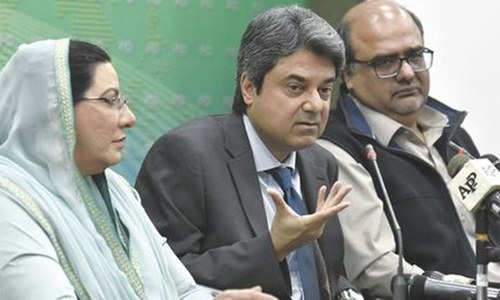
Meanwhile, Special Assistant to the Prime Minister (SAPM) on Information Dr Firdous Ashiq Awan stressed at a press conference that harmony among the state institutions was the need of the hour. She said that under the “dynamic leadership of Prime Minister Khan”, the nation would defeat the elements conspiring against the “brighter future of Pakistan”.
She said efforts were being made to demoralise the army and pit national institutions against each other. However, the government was going to fulfil its responsibility by filing a reference [against PHC chief justice] in the SJC, she said. “If you hit sixes by crossing the boundary, it will not be tolerated.”
The SAPM said India, which was continuously violating the Line of Control, was taking advantage of the situation in Pakistan.
The Minister for Science and Technology, Fawad Chaudhry, warned in a series of tweets that it would not be possible to save the country from anarchy if the army was divided or weakened.
Referring to the special court’s verdict in the high treason case against the former military ruler, Mr Chaudhry said it was the army, not Gen Musharraf, which was being targeted under a specific strategy.
“First the army and ISI [Inter-Services Intelligence] were involved in the [Tehreek-i-Labbaik] sit-in case, then the army chief’s extension was made controversial and now a popular former army chief has been humiliated,” he said in a tweet.
“The sequence of events is not a judicial or legal matter any more, it is more than that. If the institution of the army is divided or weakened, then it will not be possible to save [the country] from anarchy,” he said in another tweet. “Gen Bajwa and the current army setup has stood by democratic institutions, but this support should not be considered as a weakness.”
The tweets came a day after the special court had in a detailed verdict in the treason case ordered hanging of Gen Musharraf on five counts. The judgement is split 2-1, with Justice Shahid Karim of the Lahore High Court agreeing with Justice Waqar Seth and Justice Nazar Akbar of the Sindh High Court dissenting. The judgement was authored by Justice Seth, who wrote: “We direct the law enforcement agencies to strive their level best to apprehend the fugitive/convict and to ensure that the punishment is inflicted as per law and if found dead, his corpse be dragged to the D-Chowk, Islamabad, Pakistan, and be hanged for 03 days.”
Justice Karim agreed with Justice Seth’s decision, but not with paragraph 66, which mentions dragging and hanging of the former dictator’s body publicly for three days, saying the punishment “has no basis in law and will be ultra vires for this court to do so”.
The verdict drew angry responses from the government and the armed forces, with the former announcing its decision to file a reference against Justice Seth in the SJC. Later, Attorney General Anwar Mansoor in a private TV show negated Ms Awan’s claim that the verdict will become void if the SJC gives its decision against the judge.
Published in Dawn, December 21st, 2019