21
21
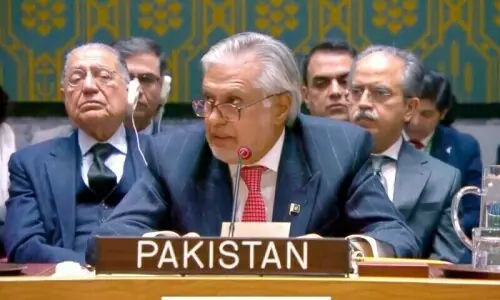
A new World Bank report, published ahead of International Women’s Day (March 8), has suggested that Pakistan should bring more reforms to improve legal equality for women in the country.
While presenting an index covering 190 economies and structured around the life cycle of working women, the report, “Women, Business and the Law 2022” put the score for Pakistan at 55.6 out of 100, which was lower than the regional average observed across South Asia.
Within the South Asian region, the maximum score observed in Nepal was 80.6 out of 100. The Women, Business and the Law (WBL) index measures explicit discrimination in the law, legal rights, and the provision of certain benefits — areas in which reforms can bolster women’s labour force participation.
Pointing out areas for improvement, the report said when it came to constraints on freedom of movement, laws affecting women’s pay, constraints related to marriage, laws affecting women’s work after having children, constraints on women starting and running a business, gender differences in property and inheritance, and laws affecting the size of a women’s pension, Pakistan could consider reforms to improve legal equality for women.
Citing an example, the report said one of the lowest scores for Pakistan was on the indicator measuring laws affecting women’s work after having children. To improve the parenthood indicator, Pakistan may wish to consider making the government administer 100 per cent of maternity leave benefits, making paid leave available to fathers, making paid parental leave available and prohibiting the dismissal of pregnant workers.
The report also pointed out that Pakistan did not allow women to register a business in the same way as men.
On a positive note, the report said when it came to laws affecting women’s decisions to work, Pakistan got a perfect score of 100. Mentioning recent reforms, the report said during the past year, from October 2020 to October 2021, Pakistan lifted restrictions on women’s ability to work at night.
The World Bank estimated that globally, differences between men’s and women’s total expected lifetime earnings was $172.3 trillion, equivalent to twice the world GDP. As such, adopting laws that strengthened women’s rights and opportunities was an essential first step towards a more resilient and inclusive world.
The report revealed that around 2.4 billion women of working age were not afforded an equal economic opportunity and 178 countries maintained legal barriers that prevented their full economic participation. In 86 countries, women faced some form of job restriction and 95 countries did not guarantee equal pay for equal work.
Globally, women still had only three-quarters of the legal rights afforded to men — an aggregate score of 76.5 out of a possible 100, which denotes complete legal parity. However, despite the disproportionate effect on women’s lives and livelihood from the global pandemic, 23 countries reformed their laws in 2021 to take much-needed steps towards advancing women’s economic inclusion, according to the report.
The Middle East and North Africa and Sub-Saharan Africa regions showed the largest improvements in the WBL Index in 2021, though they continued to lag behind other parts of the world overall.
Globally, the highest number of reforms was made in the Parenthood, Pay, and Workplace indicators. Many reforms focused on protecting against sexual harassment in employment, prohibiting gender discrimination, increasing paid leave for new parents and removing job restrictions for women.
The Pay and Parenthood indicators had the lowest average scores in the index, but they increased in the last year, rising 0.9 and 0.7 points, respectively, with average scores of 68.7 and 55.6. The gains in the Parenthood indicator were largely around paternity leave and shared parental leave, but the low score highlighted the need to accelerate reforms in this area.
Across the world, 118 economies guaranteed 14 weeks of paid leave for mothers. More than half (114) of the economies measured mandated paid leave for fathers, but the median duration was just one week.