0
0

WASHINGTON: The International Court of Justice (ICJ) lacks the power to enforce its judgments, but it can seek a UN Security Council vote on its ruling, potentially paving the way for economic sanctions or military action against Israel, legal experts and scholars argue.
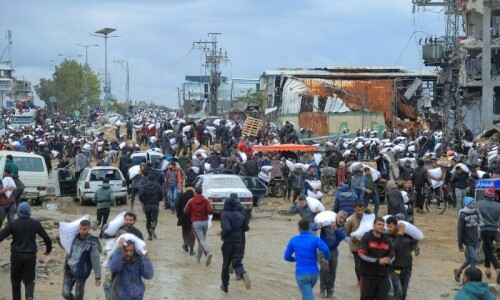
Last week, the ICJ issued a resolute order against Israel, emphasising adherence to humanitarian standards. The ruling directs Israel to prevent and penalise any public incitements to commit genocide against Palestinians in Gaza while also mandating the preservation of evidence related to such allegations. Israel is also obliged to ameliorate the humanitarian situation for Palestinian civilians in the enclave.
Commenting on the order, legal experts, think-tank scholars, and the Western media allude to the likelihood of this matter reaching the UN Security Council, where the majority is expected to demand Israel’s compliance. They contend that, this time, the United States may face an even greater challenge in defending Israel, and the ICJ ruling may prove difficult for the United States to overlook.
Emphasising the significance of the ruling, former US Ambassador-at-Large for War Crimes Issues, Stephen Rapp, noted that Israel’s noncompliance may make it difficult for its allies to continue defending the Jewish state.
“The US and all its major allies expect Israel to comply,” because “if it defies the orders, the Israeli government may find itself treated as a pariah,” he wrote in an email to The Hill newspaper that covers the US Congress.
Human Rights Watch’s Israel and Palestine Director Omar Shakir underscored the importance of the ruling, stating, “This is quite a far-reaching order. The court has the opportunity in 30 days to review Israel’s compliance or consider other options.”
Explaining how this decision could b e implemented, Shakir said in interviews to various media outlets that “the UN Security Council could take action to enforce the decision.” He acknowledged that the US veto could once again protect Israel in the Security Council but warns that the veto would further weaken the US stance on this issue, further isolating both Israel and the US in the international community.
“How many more civilians must suffer and be killed before states take action to end these atrocities?” he asked.
The Carnegie Endowment, a Washington think-tank, emphasised the crucial role the United States plays, highlighting the delicate choice the Biden administration faces in potentially using a veto to protect Israel politically.
“Why cannot the United States ignore the ICJ case against Israel?” it asked in a recent report, and then answers: “Too much is at stake: too many Palestinian and Israeli lives, too much US credibility, and too high the risk of regional conflagration.”
Elise Baker, from the Strategic Litigation Project, stressed the gravity of the ICJ’s order, stating, “The ICJ’s order is legally binding on Israel.” It outlines specific actions, including ensuring humanitarian aid distribution within Gaza and limiting military operations to facilitate aid delivery.
Celeste Kmiotek from the Atlantic Council noted the broader diplomatic ramifications, stating, “The ICJ put the countries supporting Israel on notice.” Human rights organisations have initiated legal proceedings against US and UK officials over aid to Israel, connecting them to the underlying principles of the ICJ case, he added.
The White House, while responding to the ICJ’s preliminary order, said earlier this week that the ruling aligns with the Biden administration’s demand for minimising civilian losses in the war and that’s why it does not have to change its policy towards Israel.
NBC News reported on Sunday that the US was considering slowing or pausing its arms deliveries to Israel to persuade Israel to open humanitarian corridors to Gaza. The White House, however, said that there’s no need for a change in its policy as it already requires Israel to observe international humanitarian laws.
Published in Dawn, January 29th, 2024