0
0
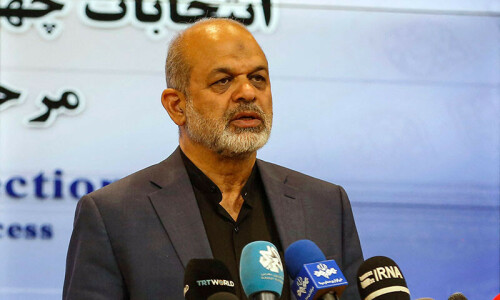
US-sanctioned former Revolutionary Guards commander Vahid Haghanian was among candidates who registered on Saturday to run for election as Iran’s president after Ebrahim Raisi died in a helicopter crash, state media reported.
Haghanian, a close aide to Supreme Leader Ayatollah Ali Khamenei, told reporters after registering that his qualifications were based on “experience from serving 45 years in the presidency and the leader’s office”.
The US Treasury designated Haghanian in 2019 among nine individuals in Khamenei’s inner circle responsible for “advancing … domestic and foreign oppression”.
Iran says most US sanctions are prompted by baseless accusations.
Former parliamentary speaker Ali Larijani, a prominent conservative, was among the candidates who registered on Friday, as was Abdolnaser Hemmati, a former central bank governor.
An election official told reporters on Saturday that 17 hopefuls had signed up since registration for the June 28 election opened on Thursday.
The Guardian Council, a cleric-led body that vets candidates, will publish the list of qualified candidates on June 11.
In the latest challenge to a ban on women running for president, conservative former lawmaker Zohreh Elahian registered on Saturday, telling reporters her motto would be: “A healthy government, a healthy economy and a healthy society”.
The Guardian Council has ruled in earlier elections that Iran’s Islamic laws prevent a woman from becoming president.
The death of Raisi — once seen as a possible successor to 85-year-old Khamenei, with whom power ultimately rests — has triggered a race among hardliners to influence the selection of Khamenei’s successor.
Moderate politicians have accused the 12-member Guardian Council of disqualifying candidates other than hardliners, who are expected to dominate the race.
However, a lack of choice on the ballot, combined with rising discontent over an array of political, social and economic crises, could reduce turnout and thus the legitimacy of Iran’s theocratic system of government.
Within Iran’s complex mix of clerical rulers and elected officials, Khamenei has the final say on all state matters such as nuclear and foreign policies. But the elected president will be in charge of tackling worsening economic hardship.
Saeed Jalili, a former chief nuclear negotiator who two decades ago ran Khamenei’s office for four years, was the first heavyweight hardliner to register for the election on Thursday.
Interim President Mohammad Mokhber has also been mentioned in Iranian media as a possible candidate.
Several lower-key moderates are also likely to enter the race.
Mohammad Baqer Qalibaf, another former Revolutionary Guards commander who had been touted as a potential candidate, was re-elected on Tuesday as speaker of parliament, making it less likely that he might stand.