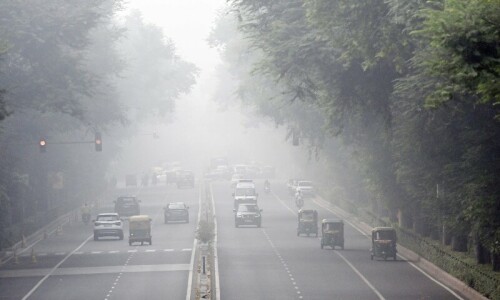
NEW DELHI: India’s capital New Delhi switched schools to online classes on Monday until further notice as worsening toxic smog surged past 60 times the World Health Organisation’s recommended daily maximum.
Various piecemeal government initiatives have failed to measurably address the problem, with the smog blamed for thousands of premature deaths each year and particularly impacting the health of children and the elderly.
Pollution extended across a swathe of northern India — with the tourists at the Taj Mahal in Agra snapping photographs of the barely visible white marble monument.
“My eyes have been burning for the last few days,” said rickshaw puller Subodh Kumar, 30. “Pollution or no pollution, I have to be on the road, where else will I go?” he said, pausing from eating at a roadside stall.
“We don’t have an option to stay indoors… our livelihood, food, and life — everything is in the open.” The city is blanketed in poisonous smog each year, primarily blamed on stubble burning by farmers in neighbouring regions to clear their fields for ploughing, as well as factories and traffic fumes.
Delhi shuts schools as ‘death trap’ smog chokes megapolis
A report by The New York Times this month, based on samples collected over five years, revealed dangerous fumes also spewing from a power plant incinerating rubbish from landfill garbage mountains. Levels of PM2.5 pollutants — dangerous cancer-causing microparticles that enter the bloodstream through the lungs — peaked at 921 micrograms per cubic metre at midday on Monday, according to IQAir pollution monitors, with a reading above 15 in a 24-hour period considered unhealthy by the WHO.
Individual monitoring stations noted even higher levels — one government-run monitor recorded PM2.5 pollutants at 1117 micrograms, 74 times the WHO maximum. Dense grey and acrid smog smothered New Delhi, with IQAir listing conditions as “hazardous”.
Published in Dawn, November 19th, 2024