Extremist influence shapes India’s posture: Gen Hayat


 0
0
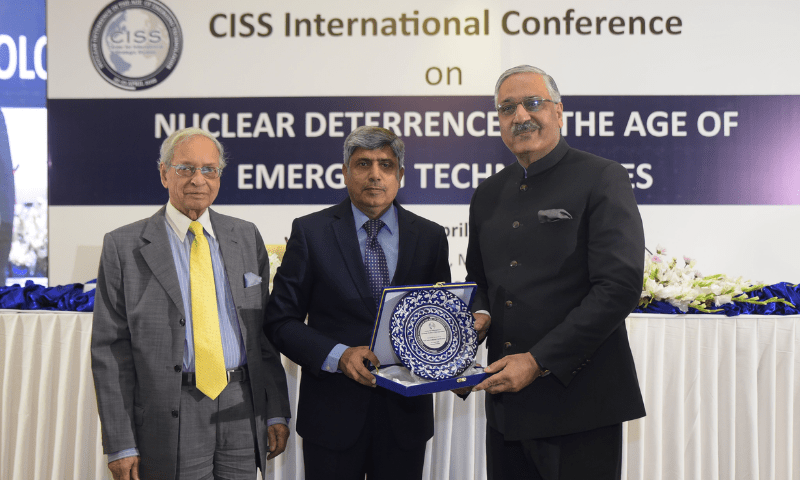
ISLAMABAD: Former Chairman Joint Chiefs of Staff Committee retired Gen Zubair Mahmood Hayat on Wednesday cautioned that the extremist influence on India’s strategic posture could destabilise the region.
Speaking at the conference on ‘Nuclear Deterrence in the Age of Emerging Technologies’, hosted by the Centre for International Strategic Studies (CISS), Gen Hayat described India as “the only nuclear-armed state governed by an extremist ideology”.
He noted the ideological alignment of India’s ruling Bharatiya Janata Party (BJP) with Rashtriya Swayamsevak Sangh (RSS), saying the government actively promotes Hindu nationalism.
“Yet, the world chooses silence. Why? Because India is a large country, and the West’s focus is fixated on containing China,” Gen Hayat said, adding that “these are the double standards, and they are dangerous for global peace and stability.”
He also criticised India’s official use of the name “Bharat” at international platforms, calling it a signal of a deeper ideological transition from a secular democracy to a “Hindu Rashtra”.
“India is no longer ‘India.’ It is now ‘Bharat,’ and this is not just a name change — it is a signal,” he said.
Gen Hayat warned that India now possessed the world’s fastest-growing nuclear arsenal and had remained the largest arms importer for over a decade. He highlighted India’s expanding missile development programme, calling it a reflection of growing military ambitions.
India’s strategic behaviour is unfolding across three dangerous dimensions: ideological extremism, technological militarisation, and political assertiveness, he said.
“With the fastest-growing nuclear programme, long-range missile development, and a decade as the top arms importer, this trifecta is destabilising South Asia,” he added.
Gen Hayat also addressed the challenges posed by “multi-domain deterrence” — a strategic concept that integrates capabilities across land, sea, air, space, and cyberspace. Previously absent from traditional deterrence frameworks, multi-domain deterrence introduces a more complex and layered challenge to the global security architecture.
The two-day conference drew experts from Australia, Canada, China, Russia, Switzerland, the United Kingdom and the United States to discuss the military implications of emerging technologies.
Published in Dawn, April 24th, 2025