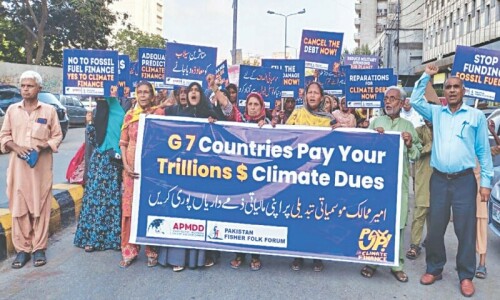
AS the world surpasses the $2 trillion mark in climate finance in 2024, a historic milestone that should inspire hope, countries like ours find little reason to celebrate.
While capital races toward clean energy and industrial decarbonisation, Pakistan, a nation acutely vulnerable to climate shocks, is once again left clutching pledges, not projects. The gap is no longer just financial; it is institutional, structural, and strategic.
The latest Global Landscape of Climate Finance report is a wake-up call. Climate finance reached $1.9tr in 2023 and likely crossed $2tr in 2024. For the first time, private finance led the way exceeding $1tr driven by electric vehicles, solar, and energy efficiency. Mitigation continues to dominate, attracting over 90 per cent of total flows. Adaptation remains sidelined with just $65 billion globally.
But while capital is flowing, it is not flowing everywhere. In 2023, only $196bn reached emerging markets and developing economies. Just 22pc came from private sources. The rest was public finance in the form of grants, concessional loans, and aid. Even within that small slice, Pakistan is barely visible.
Despite being among the top 5 most climate-vulnerable countries, Pakistan’s track record in attracting meaningful climate finance is underwhelming. Our domestic investment in green projects remains negligible. Climate finance flows into Pakistan in 2021 were estimated around $4bn, with over 84pc sourced from external partners. Our own private sector accounted for less than 5pc. Meanwhile, we need $30–40bn each year just to meet our modest climate goals.
And that’s just the beginning. Pakistan will likely face a climate investment gap of over $340bn by 2030. We are nowhere near ready to tap into the fast-moving global carbon market.
With Article 6 now enabling international carbon trading, countries are preparing to issue high-integrity credits linked to real mitigation. Pakistan has potential in nature-based solutions and renewable energy but lacks a national framework, carbon registry, and readiness pipeline.
The country’s credibility crisis, thanks to its and weak governance, has led to a trust deficit with the greater global climate finance community
Take Delta Blue Carbon, for example. It is rightly celebrated as one of the world’s largest blue carbon-offset projects. But let’s be honest, it is just one project. We need hundreds more.
Forest restoration, clean cookstoves, regenerative agriculture, wastewater treatment — the list goes on. Until carbon market readiness is treated as a national priority rather than a one-off pilot, we will remain on the sidelines.
Another unfortunate issue is credibility; Pakistan faces a trust deficit with the global climate finance community. Investors look for transparency, consistency, and delivery, but we rarely offer all three. Our project pipeline is thin and often poorly prepared. Coordination across ministries is limited and even weaker between federal and provincial levels. Financial governance is weak, procurement processes are slow, and monitoring frameworks are often missing. We have no shortage of plans — just a shortage of execution.
Pakistan lacks the technical capacity to engage meaningfully with climate finance. We have not developed the institutions or skills to speak the language of green investors.
Whether it’s accessing the Green Climate Fund, designing blended finance, or structuring Article 6 transactions, we are falling behind. Commercial banks have limited expertise in pricing environmental risk. The State Bank’s Green Banking Guidelines were a cautious step forward. By contrast, Bangladesh mandated green lending quotas and linked bank performance to sustainability metrics, an approach already showing results.
The private sector remains largely out of step with climate finance. Most companies are unaware of the opportunities, and the SMEs that anchor our supply chains are among the least equipped to access working capital for decarbonisation. Industrial transition needs financing that can unlock action — concessional loans, guarantees, and early-stage equity. It also depends on a stable and predictable policy environment, which we continue to struggle with.
So where do we begin? Project preparation is the first step. Climate finance flows to credible states, and that requires technically sound, shovel-ready proposals with clear impact. Pakistan needs a central climate finance unit, not another coordination cell, but a dedicated platform to bring together project design, monitoring and reporting systems, funding pipelines, and delivery.
At the same time, we need to operationalise carbon markets. Article 6 offers a real opportunity to raise capital through climate-positive action, but only if we establish a clear legal and governance framework that defines trading rules, revenue distribution, and environmental safeguards. Transparency and disclosure across public and private sectors must also improve.
ESG is no longer a foreign concept; it is the cost of doing business. Without trust, finance will not flow. Without visibility, investors will not engage. A national climate data platform is essential to track emissions, finance, action, and outcomes. Most of all we need political commitment that outlasts election cycles. Countries that attract climate finance treat it as an economic strategy, not charity. So should we.
A recent SPAR6C conference explored how Pakistan can tap into carbon markets under Article 6 of the Paris Agreement by building a credible Internationally Transferred Mitigation Outcomes framework. Discussions highlighted private sector engagement, scalable mitigation projects, and financing through blended models and risk-sharing.
Focus areas included transport, cement, and waste, aligned with national climate goals. Backed by the German government, the initiative aims to strengthen institutions and support Pakistan’s low-carbon transition. The momentum is encouraging, but whether it results in lasting systems and real transactions remains to be seen.
This aligns with early signs of regulatory progress. The Securities and Exchange Commission has issued Green Bond Guidelines and is developing a national green taxonomy. If implemented well, these steps could give investors the clarity and confidence they need. For the first time, Pakistan is beginning to speak the language of climate capital, but now it must deliver. The climate finance boom is real but selective.
To claim a share, Pakistan must prove it can absorb, deploy, and deliver. The window is still open, though only just.
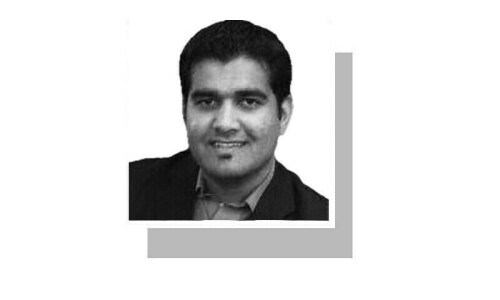
The writer is a sustainability expert associated with the Pakistan Business Council’s Centre of Excellence in Responsible Business.
Published in Dawn, The Business and Finance Weekly, July 28th, 2025