MQM-P says will be approaching other parties to set off 'grand national dialogue' on new provinces
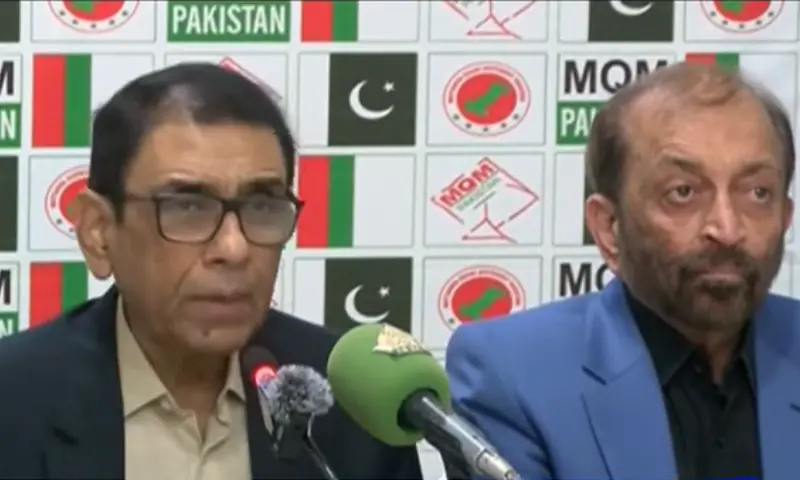


The Muttahida Qaumi Movement-Pakistan (MQM-P) announced on Sunday that it was taking the initiative to approach other parties to begin a “grand national dialogue” on the creation of new provinces in the country.
MQM-P Chairman Dr Khalid Maqbool Siddiqui made the announcement at a press conference in Karachi, where he stressed the need for a grand national dialogue on the matter.
He said his party had been contending that the creation of existing provinces in Pakistan did not meet all legal merits and had a linguistic basis.
“We have been saying for the past 40 years […] that Pakistan’s existing provinces were not created in accordance with all merits of law and were made on linguistic grounds,” he said, adding that the country’s growing population also presented the need for the creation of new administrative units.
Siddiqui expressed gratitude that various political parties and groups were choosing to support MQM-P’s “long-standing” demand for more provinces.
He said that the objective of Sunday’s press conference was to give people the message that, “regardless of your political demands, start a dialogue with each other”.
“We will talk to various political parties — a grand national dialogue is needed regarding their suggestions and reservations on the matter,” he said. “We are initiating it,” he added.
Siddiqui said, “Wherever there is support for new provinces, we will stand with that voice.”
He went on to clarify that the MQM-P was not asking for new administrative units only in Sindh but across the country; however, he noted that the case for new provinces remained “strongest” in Sindh.
The MQM-P chairman also spoke of Article 140-A, which was added to the Constitution under the 18th Amendment in 2010. It requires provinces to devolve political, administrative and financial responsibility and authority to elected local representatives.
“We took part in the sin of the 18th Amendment [so] that a common Pakistani can reap the fruits of democracy through Article 140-A,” he said, lamenting the lack of its implementation.
He recalled that the party had moved the Supreme Court against the lack of implementation, “which issued a detailed ruling on the matter that was applicable across the country”.
Siddiqui held that the demand for stronger local governance was not limited to the MQM-P and stressed that it had rather become a “need” for Pakistan.
He said the MQM-P did not have “even a single councillor” in union councils across the country and reiterated that the implementation of Article 140-A was “not just a party demand” but rather a “constitutional requirement”.
Siddiqui recalled that when the MQM-P joined the coalition at the Centre, the party had one demand: “You must empower people to reap the fruits of democracy, meet constitutional requirements and implement the Supreme Court’s decision.”
Siddiqui questioned if the creation of additional provinces was such a “sin and an act of treason, then how is it mentioned in the Constitution?”
“Yes, we can discuss the method for creating provinces, but we believe that giving provinces that right is a conflict of interest,” he said. “Who would willingly allow the division of their property?” he asked rhetorically.
Concluding his address, the MQM-P chairman said the party will engage lawyers to move the SC to take notice of the “desecration of its ruling”.
Responding to a question over whether the creation of administrative units was equivalent to the division of Sindh, Siddiqui said, “When we came here, we brought our own Sindh with us, which is Matruka Sindh.”
“The Sindhi brothers who welcomed us […] we have immense respect for them in our hearts,” he said, claiming that 60 per cent of Sindh’s land was owned by Hindus, who had “migrated to India while we came here in their place. They took our properties there”.
At this, he reiterated, “We will remember your love, and if you want, we can even observe a thanksgiving day in the spirit of our respect for you”.
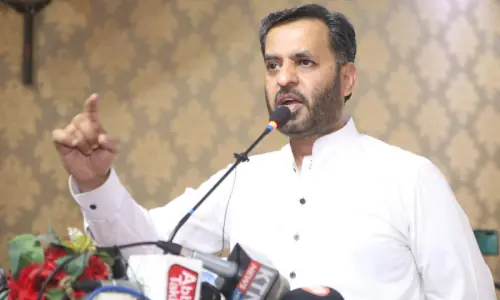
MQM-P leader and Health Minister Mustafa Kamal also spoke at the press conference and maintained that the call for administrative units was “not about division, but rather administrative rearrangement”.
He said his party was calling for a system where “people should have the right to vote for change in leadership if their city has been reduced to the third least livable city in the world”.
Kamal added that Interior Minister Mohsin Naqvi’s proposal for more administrative units had been “music to our ears, as the people running the country are realising the creation of administrative units is the only way forward”.
Naqvi made the call last month while addressing the Pakistan Economic Summit 2026 in Islamabad.
The interior minister had urged all political parties to resolve various national issues, including the question of creating new provinces. He termed this the only solution to improving the country’s overall condition, which he said had “collapsed”.
A day later, the military’s spokesperson also called on political parties to consider an administrative reset to improve governance, arguing that the country’s security and stability depended on adapting its governance structure to the demands of modern times and a growing population.
Various political parties have also been demanding the creation of more provinces or administrative units for better governance.
The MQM-P has been demanding that Karachi be designated a province separate from Sindh. However, the PPP, which rules Sindh and is also an ally of the PML-N government at the Centre along with MQM-P, has strongly opposed the suggested move.
On the other hand, the PPP and the PTI have long advocated for a South Punjab province.
The issue gained momentum after Naqvi’s proposal drew strong reactions from government ministers, while the country’s leading lawyers’ bodies adopted divergent positions.
A top government functionary recently told Dawn that there is a serious debate underway in power corridors over the most feasible approach to creating new provinces. He believed the discussion is a precursor to the proposed 28th Constitutional Amendment.
The government source, who is privy to developments, was reluctant to say when the proposal — still said to be in the initial stages — could materialise.
He conceded, however, that turning the idea of new administrative into reality would not be easy, as building a consensus among major political parties, which appear opposed to the idea, would be a major challenge.
PPP warns against division of Sindh
After MQM-P leaders’ Sunday press conference, PPP leader Qadir Mandokhail said his party was in favour of new provinces but warned against the division of Sindh, according to a statement issued via PPP’s X account.
“No political party can target the unity of Sindh for its own interests,” he was quoted as saying. Mandokhail warned that Sindh was not just a “line on a map” which could be divided on a whim.
Mandokhail said that it was a “sign of doomsday that people who had always played games of blood and fire in Sindh now appeared concerned for Sindh”.
“If they do not want to live with the people of Karachi, we can build them houses on the Sindh-Balochistan border.” Mandokhail recalled that the people of Sindh “had put to rest such slogans before”.
He held that the PPP will not allow anyone to “trample the constitution in the name of dividing Sindh”.
He slammed the MQM-P leadership for failing to have councillors in their respective constituencies. “Becoming a member of the National Assembly on a fake mandate does not make one an actual public representative,” he added.