Islamabad, Beijing activate joint border commission
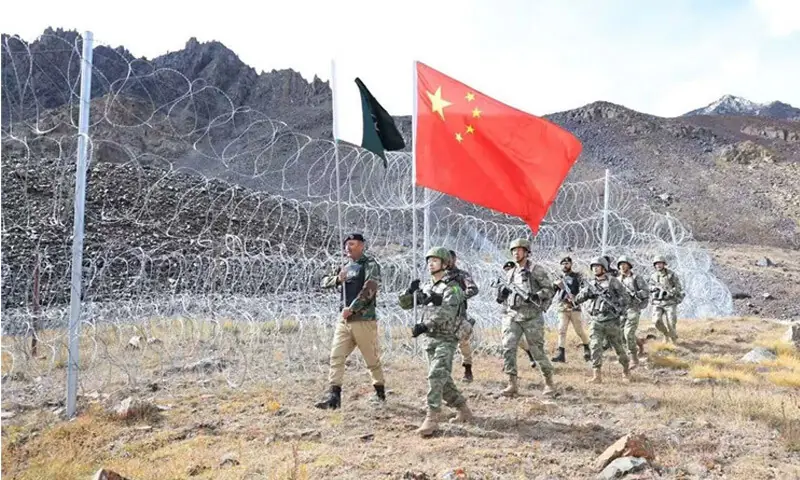
ISLAMABAD: Pakistan and China on Wednesday operationalised a long pending joint mechanism for managing their common border, with Islamabad describing the move as a significant milestone in bilateral relations and a step toward closer coordination on border management, trade and cross-border connectivity.
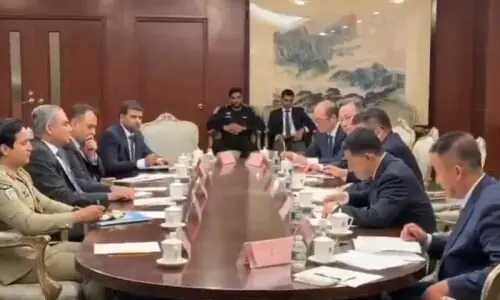
“The inaugural meeting of the Commission was held at the Ministry of Foreign Affairs in Islamabad,” the Foreign Office said in a statement.
The meeting was co-led by Li Ya, deputy director general of the Department of Boundary and Ocean Affairs at China’s Ministry of Foreign Affairs, and Bilal Mahmood Chaudhary, director general for China at Pakistan’s Foreign Office.
The FO described the operationalisation of the Pakistan-China Boundary Joint Commission as a “significant milestone for Pakistan-China relations”, saying it would set “the stage for enhanced cooperation in border management, joint border surveys, trade flows and people to people connectivity.”
The commission has its origins in the 2013 Agreement on the Boundary Management System signed during the visit of then Chinese Premier Li Keqiang to Islamabad. Article 45 of the agreement provides for establishment of the joint commission to oversee implementation of the border management arrangements.
The mechanism would provide an institutional framework for dealing with practical issues along the border, including maintenance and inspection of the boundary, joint surveys, boundary marker issues, management of cross-border facilities and handling of incidents involving the border.
Its activation also gives the two countries a mechanism for regular coordination on a border that is important for movement between Pakistan and China, including through the Khunjerab crossing, and for trade and connectivity linked to the China-Pakistan Economic Corridor (CPEC).
The new commission is distinct from the Joint Boundary Demarcation Commission that was established under the Sino-Pakistan Boundary Agreement of March 2, 1963. The earlier commission had a specific and essentially one time mandate to conduct surveys, establish boundary markers, prepare detailed maps and set out the alignment of the boundary.
Its work ended after the signing of the protocol and maps completing the demarcation process. The 1963 agreement was signed in Beijing by then-Pakistani foreign minister Zulfikar Ali Bhutto and his Chinese counterpart Chen Yi.
It also provided that, following a settlement of the Kashmir dispute between Pakistan and India, the relevant sovereign authority would reopen negotiations with China on the boundary.
The 2013 agreement, by contrast, established a continuing system for managing the already demarcated boundary, including provisions for dealing with boundary markers and cross-border infrastructure. The agreement says that if a marker cannot be restored at its original location, the joint commission can determine another suitable location, provided the boundary line itself is not altered.
India, which disputes the validity of the 1963 agreement and regards the territory covered by it as part of Occupied Jammu and Kashmir and Ladakh, rejected the new mechanism.
“We have seen reports in this regard. Our position on this matter is clear and consistent. There is no boundary between Pakistan and China. We reject the so-called Joint Commission, which is without any legal basis,” Indian Foreign Ministry spokesman Randhir Jaiswal said.
For Pakistan and China, however, the commission provides a new institutional arrangement for managing their border relationship and dealing with practical issues that have emerged since the 2013 agreement, while leaving the broader territorial positions of the parties unchanged.
Published in Dawn, September 17th, 2026