'Petrol so expensive' that PTI lawmakers arrive at Sindh Assembly on donkey carts in protest
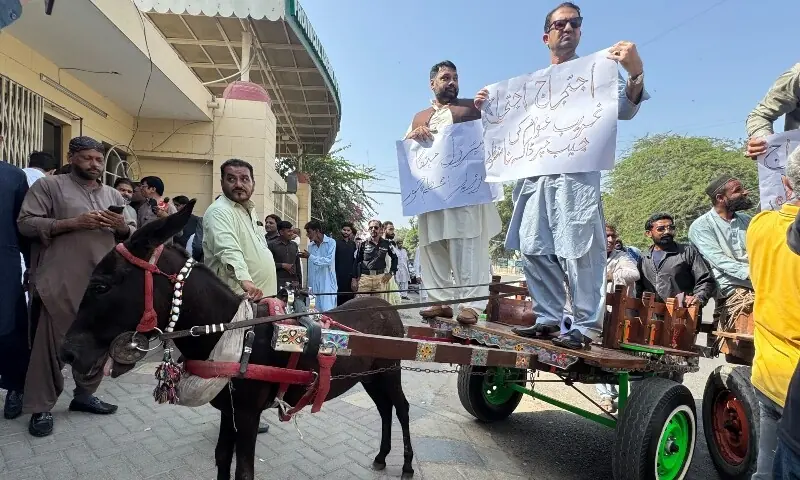
KARACHI: PTI lawmakers in Sindh arrived at the provincial assembly on donkey carts — in protest.
“The ministers and [treasury] MPAs should also reach the assembly the same way on donkey carts,” PTI’s Sajjad Ali was seen saying in a video that showed him riding a donkey cart and holding a placard as he protested the “petrol bomb dropped on the people”.
Other MPAs, led by Ali, also held placards and raised slogans against the federal government over the recent increase in petrol prices. They rode donkey carts from areas near the assembly to its main gate and demanded the government withdraw the increase in petroleum prices immediately.
Speaking on the occasion, Ali said that the protest was aimed at highlighting the plight of the common man due to skyrocketing fuel prices.
“Petrol has become so expensive that we cannot even come to the assembly in our vehicles,” he said, adding that the people were bearing the brunt of the government’s policies.
Renewed hostilities in the Middle East, which have resulted in disruption of major oil supply routes, have caused fuel prices to rise in the past two months.
Currently, the government adjusts fuel prices daily. After the latest change on Thursday, the price of petrol stands at Rs390.79 per litre while high-speed diesel (HSD) costs Rs424.92 per litre. These prices also include Rs114 per litre levied by the government in taxes and duties on petrol and Rs100 per litre on diesel.
On Thursday, a joint meeting of the Executive Committee and Rules Committee of the Pakistan Bar Council (PBC) also strongly condemned the unprecedented daily increases in fuel prices, demanding that the government take measures to control the increases and provide relief to citizens.
Meanwhile, the government has introduced a “relief scheme” for users of motorcycles, autos and vehicles of up to 800cc to “alleviate the burden” of rising global oil prices.
Under the scheme, motorcycles, rickshaws and Qingqis, as well as other two- and three-wheeler users, are eligible for relief on 20 litres of petrol per month. The owners of small cars with engines up to 800cc will receive the Rs100 per litre relief on 30 litres of petrol every month.
The subsidy scheme faced snags on Thursday, the first day of its nationwide rollout, as many petrol pumps declined to honour the digital app launched for the purpose, claiming that they lacked the system needed to provide petrol at Rs100 per litre less.
The same day, the federal government also reintroduced austerity measures, including setting 9pm as the closing time for markets and reducing fuel provision for official vehicles by 50 per cent for a period of three months.