PESHAWAR: The Khyber Pakhtunkhwa government seems unmoved by the protest of trainee medical officers and house officers, who have been on strike at medical teaching institutions (MTIs) for the past two weeks to demand 30 per cent hike in stipends.
Provincial Health Minister Khaliqur Rahman said that their pay was increased in July 2026 after cabinet’s approval. He said that he had asked about doctors’ stipends in other provinces so that he could take their case for bringing the stipends at par with others.
He said that he was in contact with agitating medics as the strike initiated for no reason and affected common patients. “We are trying to make them understand,” he said.
The minister said that the strike was affecting patients. “They should try to understand instead of disrupting patient care for no reason,” he added.
Health minister says stipend of protesting medics was increased in July
The protest, launched on September 7, still continues in MTIs with no hope in sight for its end as the government claims that stipend has been raised by 15 per cent on September 10 with arrears from June. However, trainee medical officers (TMOs) argue that their colleagues in Punjab get higher stipends than them.
Khyber Pakhtunkhwa has about 600 doctors, 53pc female, enrolled for five-year training in 74 different specialties in its own MTIs and other provinces, recognised by College of Physicians and Surgeons (CPSP) for postgraduation. Postgraduate Medical Institute (PGMI) manages the training of TMOs.
PGMI receives Rs8.6 billion budget per year of which 98pc goes to stipends of TMOs and the rest of 2pc is consumed by operational cost.
Sources said that PGMI had long been recommending the government to raise the stipend by 15pc but it was increased in the middle of the protest due to which it couldn’t satisfy TMOs. Had it been increased a few months ago, the situation would not have come to such a sorry state of affairs as all the MTIs were brought to a standstill. A notification issued by the finance department said that every year stipend would be increased by 5pc.
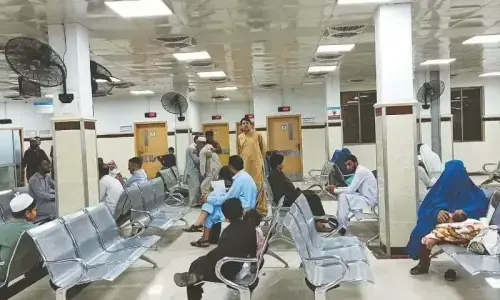
Senior officials said that TMOs were convinced that they had already continued their protest for a fortnight and calling it off at that stage would serve no purpose, therefore, the strike continued and OPDs, wards, operation theatres, diagnostic departments stayed closed.
Only accident and emergency departments are operational where critically-ill and injured patients get services uninterruptedly.
Dr Khalid Kamal, a member of the council formed by TMOs, said that trainee medical officers and house officers were the backbone of provincial tertiary-care teaching hospitals.
“We played major role in 24-hour MTI operations including emergency, operation theatres (OTs), intensive care units (ICUs) and outpatient services and our colleagues handle all emergency patients,” he said.
He said that the protest was launched because TMOs and HOs managed wards, responded to emergencies and ICUs, assisted in surgeries, attended calls and continued providing medical care to patients around the clock with full responsibility and dedication.
Dr Khalid said that owing to full-time hospital commitments, they had no opportunity to make additional income through private practice. At the same time, substantial salary revisions had been made across government departments but they were left out of raises made in the past, he added.
In Swabi, trainee medical officers and house officers also boycotted duty to demand increase in stipends.
The protesting doctors threatened to continue boycott in case their demand for raise was not met.
They said that the big issue was that prices of commodities and other expenditures had been increased manifold during the last one decade but their stipends remained the same and the government did not take a single step for increasing salary of HOs and TMOs.
Dr Shakoor Ahmad said that price of commodities had witnessed increase about 300pc but TMOs and HOs received the same salary. He said that they opposed the policy and demanded increase in their monthly stipends.
When they were asked about the next step, the protesting doctors said that they would soon decide it but their target was to close outpatient departments (OPDs) in all hospitals in the province.
They said that if that strategy didn’t work then they would have no option but to close emergency and accidents departments also. They criticised the behaviour of rulers and said that government did not take interest in solution of their problems.
Published in Dawn, September 21st, 2026