ISLAMABAD: Pakistan’s nuclear electricity production increased by 3.7 per cent to a record 22.5 terawatt-hours (TWh) in 2025, while solar power generation expanded even faster amid unaffordable overall energy prices.
Pakistan’s “nuclear electricity production has increased from 21.7TWh net in 2024 to a new all-time high of 22.5TWh in 2025,” says the World Nuclear Industry Status Report (WNISR) 2026, based on data for the period ending July 2026.
“For the first time, solar power generation exceeded nuclear output — and by far — with 36.3 TWh,” the report said, describing the figure as highly underestimated.
The WNISR 2026 is financed by the German Federal Office for the Safety of Nuclear Waste Management, the Austrian Federal Ministry for Agriculture and Forestry, Climate and Environmental Protection, Regions and Water Management, the Greens/EFA Group in the European Parliament and the Swiss Energy Foundation.
Solar generation reaches 36.3 TWh, surpassing nuclear production for first time
The report noted that the US leads the world, with 94 operating reactors and a nuclear generation capacity of 96,952 megawatts (MW), followed by France with 63,000MW from 57 reactors and China with 61,521MW from 63 reactors.
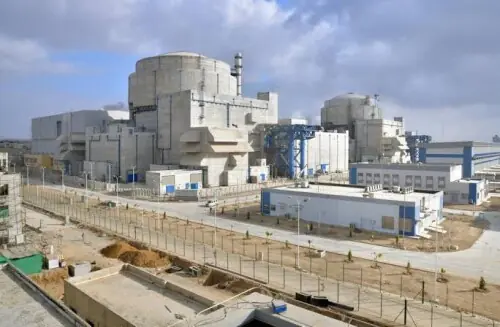
Despite being the pioneer in connecting nuclear power to the grid in 1954, Russia ranks fourth, with 27,969MW from 34 reactors, up from 26,800MW in 2023. Pakistan operates six nuclear reactors with a combined operating capacity of 3,262MW. All six operating reactors were built by the China National Nuclear Corporation (CNNC), including the two Hualong One reactors, Kanupp-2 (K-2) and Kanupp-3 (K-3), outside Karachi, and four 300MW Chashma nuclear reactors.
The WNISR, citing the Pakistan Economic Survey 2025-26, said the country’s share of debt repayment was notable in the total cost of electricity generation from nuclear energy. The debt is mainly associated with the newly constructed K-2 and K-3 reactors, commissioned in 2022 and 2023, respectively.
According to the survey, the 12-year debt repayment period “is only 20 per cent” of the reactors’ estimated economic lifetime of 60 years.
The Kanupp site also houses a 90MW CANDU (K-1) reactor, which was closed in 2021 after 50 years of operation.
The Chashma Nuclear Power Generating Station (CNPGS) comprises four operating reactors, C-1 to C-4, with a total capacity of 1,230MW. CNNC is also building another 1,000MW Hualong One reactor at the Chashma site, known as C-5.
The agreement to build the reactor dates back to 2017, but it took more than seven years to progress to formal construction. The first concrete pour for the base slab of the reactor building took place on Dec 30, 2024. C-5 is expected to be completed by 2030 and is China’s only ongoing nuclear new-build project abroad.
Solar revolution
The report said Pakistan’s solar revolution apparently did not reflect the full deployment of solar technology in the country. A mysterious decline in power consumption despite economic growth was later explained by import statistics: private, unregistered photovoltaic installations had enabled considerable self-consumption that did not pass through the public grid.
Between the beginning of 2017 and mid-2026, Pakistan imported a cumulative total of more than 58GW of solar panels from China. Of this, 40GW, or 69pc, was imported during the two and a half years from 2024 to mid-2026. Pakistan has consequently become the second-largest single-country import market behind the Netherlands, which acts as a hub for Europe.
“Pakistan installed in five years about twice as much solar capacity as France did in a decade,” the report said.
In 2025, Pakistan was China’s top customer for solar panels. By summer 2025, solar had become Pakistan’s single largest source of electricity.
Published in Dawn, October 5th, 2026