‘Abandoned province’: Amir Muqam slams PTI, says not in favour of governor’s rule in KP but security risks persist
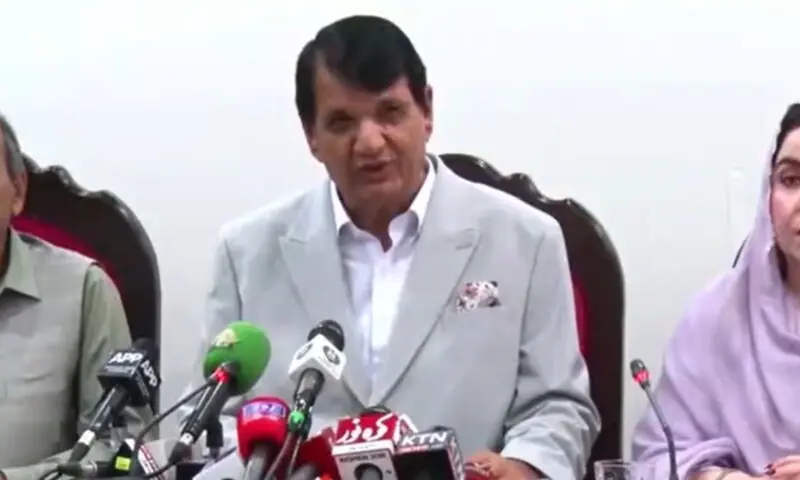

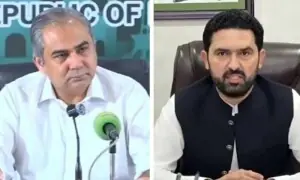
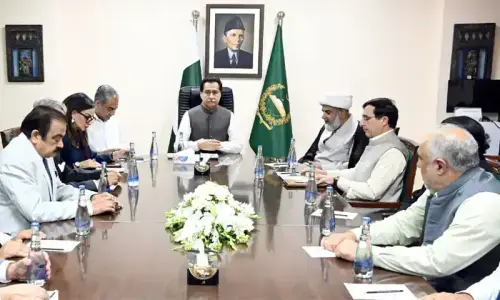
Minister for Kashmir Affairs and Gilgit-Baltistan Amir Muqam on Monday slammed the PTI-led government in Khyber Pakhtunkhwa, stressing that the federal government was not “in favour of governor’s rule” amid the party’s march, but warning of national security risks.
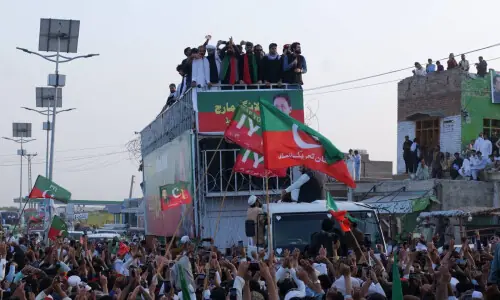
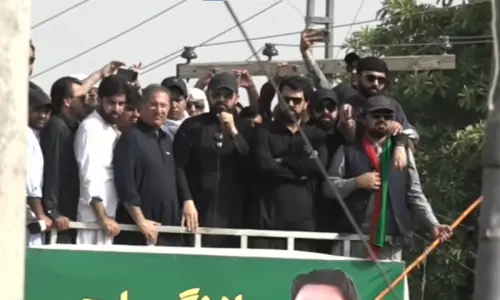
The minister’s comments came as KP Chief Minister Sohail Afridi launched the party’s long march towards Islamabad on Sunday, saying that the party would “not accept” any policy against the interests of the people of KP.
PTI went ahead with its march despite warnings from the federal government. The government has threatened to send the PTI government in KP packing by imposing governor’s rule or an emergency if the party proceeded with the march.
The march was announced as part of its nationwide protest to demand the release of its founder, Imran Khan. It has become a major bone of contention between the government and the main opposition party, with both taking entrenched positions.
Addressing a press conference on Monday, Muqam said, “We are not in favour of having governor’s rule or declaring an emergency in KP as politically it is not a good decision; however, on the one hand, you have politicians, and then there is the state. Politics can only continue if we still have control of the province.”
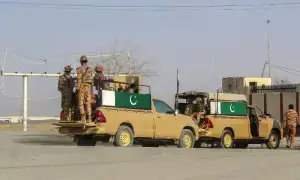
He claimed that the provincial government had lost its writ and that “the security situation was deteriorating day by day”.
Speaking about the recent negotiations with the opposition over the party’s march to Islamabad, the minister said the government’s side had suggested that they “be on the same page” about terrorism.
Muqam said the province’s chief executive had “abandoned” the province.
“There is no sign of the government in the province. The chief executive of the province stays busy with his one-point agenda.”
He said terrorism was not limited to KP.
Muqam went on to warn, “If KP is overtaken by terrorists [..] then the rest of Pakistan would not remain free either.”
He said the provincial government, the federal government and the armed forces “should be on the same page” in counterterrorism efforts.
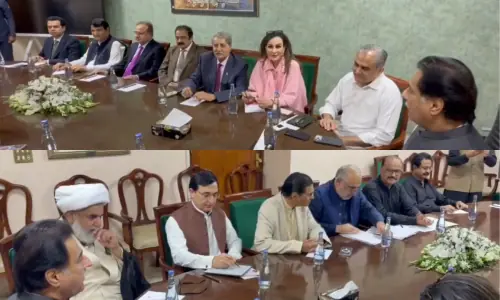
Shifting his attention to the weekend’s negotiations with the opposition, Muqam applauded the opposition’s delegation, saying that they were willing to find a resolution.
He recalled that during the first day of the talks, the opposition asked for an extension since the KP CM needed to be a part as well.
“The next day, we came back and sat from 3pm till 3am. In the talks, three to four drafts were prepared, and at one point, it was decided that we would issue a joint statement.”
He said that at the time, the opposition’s delegation had assured the government side of their cooperation. He recalled that the “interference” began after 9pm on Saturday.
“Messages came in asking for clauses to be added and removed. In the end, we had a deadlock,” Muqam said.
The minister said it was “highly unfortunate” that the talks had ended. He also questioned how the KP CM was making statements regarding the march while “his nominated people were engaging in talks”.
He claimed that government-related work in KP had come to a halt over the past two to two-and-a-half months.
Muqam reiterated that the federal and provincial governments “needed to be on the same page”.
He also questioned the provincial government’s “lack of seriousness” over the National Action Plan (NAP).
“Why have you held only one meeting in the entire year? How many martyrs have you visited?” Muqam asked.
“In fact, you went against the police to try to rob them of their authority,” he said, referring to the KP Police Act, 2026. During his press conference, Muqam reiterated that PTI’s march would not be allowed to enter Islamabad.
“What is this drama of proceeding with the march when you know fully well that you will not be allowed to enter Punjab?” Muqam said to PTI. He questioned whether the KP government had spoken about the rights of the people of KP.
“It is the state’s responsibility not to leave the people of KP at the mercy of terrorists, and for that, there is a constitutional way to provide them relief,” the minister said, in an apparent reference to governor’s rule.
Asked about further negotiations with the opposition, the minister said the “door to talks is still open [..] if it is for the betterment of the country, we are always ready to talk”.
‘Terrorism, not politics, is the problem’
Separately, Defence Minister Khawaja Asif also emphasised the gravity of the security situation in KP and appeared to be holding the PTI’s provincial government for the prevalent terrorism.
“The state and KP’s problem is not politics but terrorism,” he began in a post on X before sharing some terrorism-related data.
According to Asif, around 6,200 terrorism incidents took place in the province over the past two years, 1,200 personnel were martyred and 37 suicide attacks by Afghans were recorded.
“Fourteen suicide attacks have place in the ongoing year, most of which have the involvement of Afghans.”
Moving on to law enforcement agencies, he said the total number of police personnel in KP was 125,000, and 13,000 among them were deployed for VIP protocol.
On the other hand, he claimed, 17,000 police posts remained vacant “in a province where police is playing an important role [against] terrorism”.
He went on to allege that the “Counterterrorism Department’s (CTD) system is nearly non-functional in the merged districts”. According to Asif, the department has just 17 bulletproof vehicles and the total number of CTD personnel around 3,300. Among them, only 25 were permanent employees and rest were contract-based employees, he claimed.
The defence minister then accused the government of trying to undermine the police’s capacity by “using the Police Act 2017 for political purposes”. He further alleged that police had sought funds worth Rs42 billion for the reconstruction of police posts, but the provincial government released just Rs1.2bn.
“Lives are being lost everyday due to the non-provision of funds. On the other hand, expenditure of Rs42bn has been claimed in papers, when in reality, this amount has been embezzeled,” he continued to allege.
In this scenario, Asif claimed, the PTI’s stance had been that if security forces had been guarding the frontiers how come terrorists were able to infiltrate into the country. Noting that the PTI had been in the government in KP for the past 13 years, he claimed “Imran had a soft spot for the Tehreek-i-Taliban Pakistan (TTP)” — an outlawed terror outfit — and the PTI’s view had been more inclined towards holding talks with terrorists.
He accused Imran of “pushing the entire security system towards talks with the TTP and its allied groups”.
“Pakistan and Khyber Pakhtunkhwa paid the price for this policy,” he regretted. “Yet, this party (PTI) is talking about engaging the TTP and TTA (Tehreek-i-Taliban Afghan) today.”
The defence minister asserted that the state had a clear policy on terrorism now: terrorists should be eliminated. “The state policy is not hold talks with terrorists but taking action against them and eliminating them.”
Asif said the KP government’s policy was contrary to the state policy. He said there had been accusations that the fight against terrorism was for “dollars”.
“Tell us, how many billions of dollars has America provided to Pakistan in the past few years for the fight against terrorism and security?” he questioned. “Tell us, are the drone strikes in Kohat and Peshawar and the TTA attacks on Pakistani security posts not real? When terrorists themselves are using drones, why can’t the army use drones for its own defence?”
Raising several questions regarding counterterrorism measures taken by the PTI, he also refuted the KP government’s allegation that they were not being provided funds by the Centre.
“There is no lack of funds, but corruption and weak governance diminish their impact,” he claimed.
The defence minister continued, after claiming funds transfers to KP on several accounts, that “the number of pending prosecution cases is over approximately 3,000, but no terrorist has been executed yet, nor has any punishment been awarded”.
He said the state’s clear policy was “hold, build and transfer”.
“First secure and hold the areas, then begin reconstruction and build an institutional structure and then transfer [the control] to the civil administration,” he elaborated. “The question is why are you not applying the policy of hold, build and transfer in these areas? Your judiciary and civil administration should step forward to take charge of managing these areas,” he concluded.
Opp-govt dialogue failure
Over the weekend, the government and opposition held two rounds of talks, which did not yield positive results, with counterterrorism policies and access to Imran emerging as two major sticking points.
On Sunday, the PTI said it wanted immediate access to party chief Imran for consultations, and even agreed to forgo other demands in return for a meeting with Imran. However, the government declined to make access to Imran part of the proposed agreement, the opposition party claimed.
Another deadlock was terrorism in KP. The federal government asked the KP government to support its counterterrorism measures and support emergency measures within 72 hours in the merged tribal districts, the PTI said.
Instead, the PTI proposed that authorised representatives of the federal and KP governments meet within 72 hours to develop a clear, comprehensive and mutually agreed strategy for peace and counterterrorism, the statement added. The PTI said the health and medical treatment of Imran Khan was also raised as a matter of fundamental importance.
Meanwhile, PTI leader Salman Akram Raja, who was a part of the opposition’s delegation, said the primary reason for the failure was disagreement on anti-terrorism actions in KP.
Raja said the opposition stood firm on its principled position that anti-terrorism actions should be based on an agreement between the federal government and the KP government, and would be framed in consultation with stakeholders.
After talks between the government and the opposition ended without headway, Interior Minister Mohsin Naqvi on Sunday accused CM Afridi of “sabotaging” negotiations.
On Sunday, Naqvi also held a meeting with the KP Governor Faisal Karim Kundi to discuss the political and security situation amid speculations of ‘imminent’ governor’s rule in the province. A government source told Dawn that the government was seriously considering the imposition of the governor’s rule in KP.