JUI-F decries ‘coordinated campaign’ against Fazl

• Slams alleged drone filming of leaders’ homes, character assassination on social media
• Maulana calls for transparency in foreign investment deals
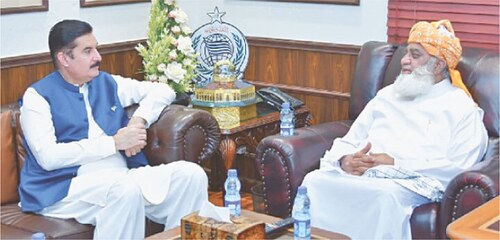
QUETTA / LARKANA: The JUI-F staged protests in different parts of Sindh and Balochistan on Friday, decrying what it called a “coordinated character assassination campaign” against its leader, Maulana Fazlur Rehman.
In Balochistan, protests were held in district headquarters across the province, including Quetta, Khuzdar, Awaran, Musakhel, Harnai, Lasbela, Qila Saifullah, Ziarat, Nasirabad, Jaffarabad, Chaman, Pishin, Kalat, Mastung and Kohlu.
Party office-bearers, workers, religious scholars, political and social figures participated in the demonstrations, expressing their solidarity with the Maulana.
Addressing the gatherings, speakers praised the Maulana’s role in safeguarding the Constitution, democracy, parliamentary supremacy, religious values and public rights.
They said the alleged aerial surveillance of his private residence through a drone and the subsequent circulation of the footage on social media were unacceptable in any civilised society.
They emphasised that the protection of privacy and the sanctity of one’s home were fundamental rights of every citizen, adding that unjustified interference in anyone’s private life violated moral, legal and constitutional principles.
The speakers said it was deeply regrettable that political differences were being turned into personal vendettas, character assassination, unethical campaigns and violations of personal privacy.
Such actions, they argued, could intensify political tensions and create unrest and resentment in society. In democratic societies, differences of opinion should be addressed through dialogue, arguments and constitutional struggle rather than targeting individuals’ private lives or launching negative propaganda campaigns on social media.
They demanded an immediate, transparent and impartial investigation into the alleged drone filming of Maulana Fazlur Rehman’s residence. They called for those responsible, including the individuals allegedly involved behind the scenes, to be identified and dealt with in accordance with the law.
They also condemned the use of social media for character assassination, false allegations and organized negative campaigns instead of promoting political debate and public awareness. They stressed that those involved in such activities must be brought to justice.
Meanwhile, a meeting of JUI-F Sindh leaders expressed concern over the drone filming of the residence of its general secretary Maulana Rashid Mehmood Soomro, the issuance of NAB and FIA notices to Mufti Asad Mahmood, Kamran Murtaza and other leaders, and the sealing of shops in various cities.
Terming them acts of government panic and political vendetta, the gathering insisted that the Maulana and his party were being subjected to vindictive action for raising their voice against the “Form 47 government”, for the unity of the provinces, the NFC Award and the possible 18th Constitutional Amendment, and against what they termed conspiracies to seize the provinces’ mineral resources.
They stressed, however, that the party would not be intimidated and would continue its constitutional, legal and democratic struggle. The meeting announced that, on the directive of the party chief and in line with a policy of non-violence, protests would be held on highways and major roads.
Transparency in investments
Meanwhile, addressing a gathering of the Jamiat Talaba Islam in Islamabad, the Maulana called for transparency in agreements with foreign investors, particularly those involving Pakistan’s mineral resources, stressing that the country’s natural wealth should not be exploited through secret arrangements at the expense of its people.
He said his party was not opposed to investment from China, the US or multinational companies, but all agreements must be made public, with clearly defined shares of profits for Pakistan, foreign investors and local communities.
“We are not against anyone’s investment, but there must be transparency in the process and agreements. The nation should be informed about the conditions under which contracts are signed,” he said.
The Maulana also alleged that the government was using security measures in tribal districts to facilitate illegal trade routes.
Referring to recurring curfews in parts of the tribal belt, he questioned why restrictions were imposed for two days a week while the remaining five days were apparently considered free of terrorism.
Published in Dawn, November 7th, 2026