FCC on workplace harassment

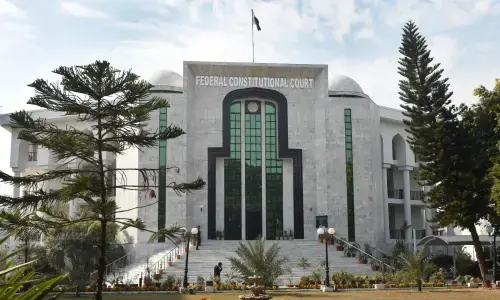
THE commentary that followed the recent Federal Constitutional Court (FCC) judgement dismissing the harassment claim of an NBP employee gives the impression that the court has rolled back the scope of the workplace harassment law so that it now covers only incidents of an overtly sexual nature, excluding conduct that amounts to gender-based discrimination. This is incorrect.
The correct position of the law now is this: allegations of workplace harassment prior to 2022 (which is when the Protection Against Harassment of Women in the Workplace Act was amended) must involve conduct of an overtly sexual nature to fall within the scope of the law. Actions that take place after the 2022 amendment are covered by the law not only if they are overtly sexual in nature, but also if they are rooted in gender-based discrimination. Let’s see why.
First, let’s look at the definition of ‘harassment’. Prior to January 2022, it was defined to cover “any unwelcome sexual advance, request for sexual favours or other verbal or written communication or physical conduct of a sexual nature or sexually demeaning attitudes, causing interference with work performance or creating an intimidating, hostile, or offensive work environment, or the attempt to punish the complainant for refusal to comply to such a request or is made a condition for employment”.
This definition was amended in January 2022 by adding the following: “discrimination on basis of gender, which may or may not be sexual in nature, but which may embody a discriminatory and prejudicial mindset or notion, resulting in discriminatory behaviour on basis of gender against the complainant” (Section 2[h][ii] of the Act).
The court interpreted the original definition restrictively, following the reasoning of the first Nadia Naz judgement.
The amendment was made after the 2021 Supreme Court decision in Nadia Naz vs President of Pakistan. This case, which analysed and applied the original, pre-2022 definition of harassment, concluded that the law only covers harassment of an overtly sexual nature.
The 2022 amendment, passed a few months after the judgement, rectified the limitation in the original definition as interpreted by the Supreme Court in the Nadia Naz judgement of 2021. The amended definition explicitly includes gender-based discrimination within the meaning of harassment.
The amended definition would not apply retrospectively. The expanded definition, which broadens the scope of the actionable wrong, would only cover actions that take place after the amendment.
But in 2023 the Supreme Court, reviewing the Nadia Naz judgement, held that the original definition was broad enough to include gender-based discrimination. Harassment as originally defined should be interpreted to include conduct that is not overtly sexual in nature but amounts to gender-based discrimination. The Supreme Court declared that the bench’s interpretation of the original definition was too restrictive.
The interpretation in the Nadia Naz judgement on review would be brilliant were it not for the 2022 amendment. By interpreting the original definition to have essentially the same meaning and effect as the 2022 insertion, the Supreme Court implies that the 2022 amendment was redundant. This contradicts a basic principle of statutory interpretation, which requires that each statutory provision should be interpreted to give it a distinct meaning.
It may well be that the 2022 amendment was not needed because the original definition should be interpreted as broadly and purposively as the Supreme Court did in the Nadia Naz judgement on review. But when the legislature amended the definition in 2022 to explicitly cover gender-based discrimination, it also implied that the earlier definition was restrictive, which is why the amendment was needed.
By explicitly expanding the definition, it endorsed the view that the original definition did not cover gender-based discrimination.
The FCC in its recent judgement did the same. The FCC interpreted the original definition restrictively, following the reasoning of the first Nadia Naz judgement. It did not refer to the 2022 amendment, and it did not need to because the incidents involved in the case predated the amendment. The amended definition would not apply to these facts. It would have been more edifying if the FCC had clearly explained this, but lucid, well-written judgements are unfortunately uncommon.
Let’s say, as many have argued, that the FCC should have interpreted the original definition more broadly to include gender-based discrimination. What implication would that have for the current definition of harassment? Such an interpretation would entail that the second part of the definition is redundant because the first part covers conduct embodying gender-based discrimination. Such reasoning would again contradict the principle of statutory interpretation, which says that the legislature does not waste its words.
The FCC decision is deeply flawed, but for another reason. The FCC has not applied its own interpretation properly. The harassment at issue in this case was overtly sexual in nature. The evidence put forward at the earlier stages of the case, before the Islamabad High Court and the ombudsperson, shows that the complainant faced harassment that was unambiguously sexual. It is disturbing that the FCC did not consider this conduct to fall within the scope of the original definition.
Flawed as it is, the FCC has not overruled the 2022 amendment to the law. The expanded definition (Section 2(h)(ii)) still stands, but it will only apply to incidents that took place or are alleged to have taken place after the date of the amendment. Prior incidents will be covered by the original definition, which will be interpreted restrictively.
This clarification is important because after the FCC ruling and the outrage against it, many potential claimants believe that the pervasive gender-based discrimination they currently face at the workplace is not covered by the law. People sitting on workplace harassment committees have told me that their mandate is now restricted to only incidents that are overtly sexual in nature. We must remind them that it is not.
The writer is a lawyer and the author of Progressive Laws In Patriarchal Societies.
Published in Dawn, November 8th, 2026