President, PM say Iqbal’s vision continues to serve as a 'guiding beacon' for Pakistan

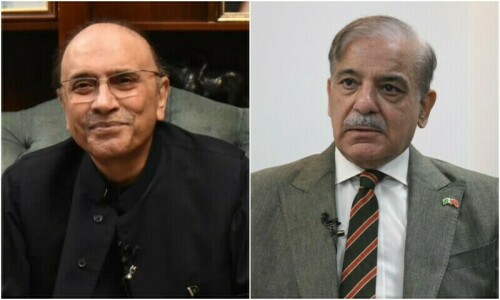
Prime Minister Shehbaz Sharif and President Asif Ali Zardari on Monday paid tribute to Allama Muhammad Iqbal — the poet of the East — on his 149th birth anniversary, stressing that the poet’s message of unity and peaceful coexistence continued to serve as a “guiding beacon” for the country.
Born in Sialkot in 1877, Iqbal was a distinguished poet, a scholar, a gifted philosopher and Pakistan’s ideological founder. It was at the Allahabad session of the Muslim League in 1930 that Iqbal became the first politician to articulate the two-nation theory that ultimately led to the creation of Pakistan on August 14, 1947.
Last week, the federal government announced November 9 as a public holiday on account of Iqbal Day. A Change of Guards ceremony was held at Iqbal’s mausoleum in Lahore on Monday morning, Radio Pakistan reported.
In his message, the prime minister said that Iqbal was responsible for awakening political consciousness among the Muslims of the subcontinent, inspiring them to recognise and assert their distinct national identity.
“This consciousness of a separate identity played a pivotal role in their historic struggle for the creation of an independent homeland,” the premier wrote.
“Allama Iqbal was a person of exceptional intellectual stature and profound wisdom. The enduring thought of this eminent philosopher and visionary continues to broaden intellectual horizons and foster the intellectual growth of our youth and future generations.”
PM Shehbaz further stated that Iqbal, as a distinguished philosopher of Islam, explored the intellectual dimensions of Islamic teachings.
“His Islamic thought continues to offer meaningful and practical guidance to Muslims in their individual and collective lives.”
The premier also announced that the government will be holding a year-long commemoration of the 150th anniversary of Iqbal, culminating on November 9, 2027.
“A comprehensive programme of national and international events is being formally launched, featuring international conferences, academic and research seminars, literary festivals, exhibitions, educational competitions and cultural activities.
“These commemorative initiatives aim to preserve and transmit Iqbal’s rich intellectual legacy to future generations.”
He further added that the government remained committed to ensuring that Iqbal’s philosophy was a part of the education system and national discourse as well as development priorities.
“Intellectual awakening, character building and collective renewal must, undoubtedly, form an essential part of our national objectives.”
Speaking of Iqbal’s concept of Khudi (selfhood), the prime minister said that it taught that “Individuals and nations can transform their destinies through self-realisation, purposeful endeavour and spiritual emancipation.”
PM Shehbaz further stated that Iqbal had regarded youth as “architects of the nation’s future.”
“His concept of the Shaheen (falcon) embodies courage, independence, lofty aspirations and an unwavering pursuit of excellence.”
PM Shehbaz said that Iqbal’s thoughts spoke of peace, social harmony, tolerance, and justice as “indispensable pillars of sustainable national development.
“His philosophy of life categorically rejects hatred, extremism, sectarianism and discrimination.”
He also noted that Iqbal’s message of “muslim unity, universal brotherhood and peaceful coexistence” held relevance on an international level. He added that Pakistan will continue to work on developing unity and solidarity among the Muslim ummah and the resolution of international disputes.
“Allama Iqbal’s timeless message, rooted in individual, national and universal values, continues to illuminate our path and serve as a guiding beacon for the nation.”
Concluding his statement, the prime minister pledged to renew resolve to deepen the understanding of Iqbal’s message, promote “rigorous” scholarly research into his thought, foster creative thinking and strengthen our national character.
Must take inspiration from Iqbal’s poetry to boost ‘spirit of inquiry, develop critical faculties’
President Zardari also spoke of Iqbal’s role in developing political consciousness among the Muslims of the subcontinent as he paid tribute to the poet, urging the country’s youth to take inspiration from Iqbal’s poetry “as a catalyst to boost the spirit of inquiry, develop critical faculties.”
“Iqbal gave intellectual direction to the aspirations of the Muslims of the Subcontinent. His poetry also spoke to a wider human struggle: the pursuit of freedom, equality and a life of self-respect,” a statement issued by the president’s office quoted him as saying.
He continued: “Iqbal envisioned a society in which wealth, privilege and inherited status would no longer determine a person’s worth or opportunities.”
The statement added that Iqbal’s poetry sought to challenge exploitation, awaken the poor, and uphold the dignity of labour.
President Zardari stressed that Iqbal’s vision called to “build a Pakistan where the worker receives a fair wage, the farmer enjoys the fruits of his labour, and every child can learn and advance, regardless of family circumstances, gender or faith”.
He also spoke of Khudi, stressing that “national self-respect demands the capacity to make independent decisions, develop our own strengths and engage with other countries on the basis of equality and mutual respect.”
“For me, fidelity to Iqbal’s vision means building a Pakistan where no citizen’s dignity is diminished by poverty, no child’s future is limited by birth, and our nation stands among others with confidence and self-respect,” the president was quoted as saying.
He further stated that Iqbal’s vision had gained renewed significance as the region looked towards the “dawn of an Asian century”.
“The promise of that century must reach beyond economic growth to embrace freedom from hunger, access to knowledge and opportunity, and respect for the sovereignty of nations. Pakistan must help realise this promise through education, scientific progress, regional cooperation and peace.”
President Zardari urged the youth to translate Iqbal’s concept of Khudi into “confidence rooted in knowledge, national self-respect into hard work to transform Pakistan into a developed and strong nation, and the ideal of equality into justice in everyday life.
“This is how we can honour Iqbal and fulfil the promise of Pakistan.”