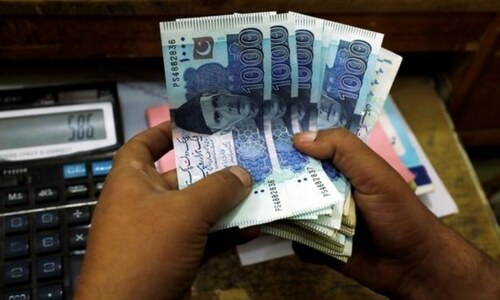
THE slight increase in workers’ remittances reported for October prompted a host of questions directed to me. Here are the responses.
The rise is too small to matter. In fact, it falls far short of what it needs to be to serve its purpose: helping plug the trade deficit. There is no reason in the world for celebration based on one data outturn. What matters is the trend that a series of data points describe; most often, that trend is intelligible only when seen in its proper context.
So what is the proper context for remittances? First, remittances are traditionally how Pakistan’s economy finances its trade deficits. The trend is cyclical and reveals itself when you take a 12-month average of the total trade balance plus remittances, then plot that on a month-to-month basis. You will notice something. A wavy line emerges. From a low point in 2015, it rises slowly until it briefly turns positive — around $40 million — in November 2015. Then it plunges back below the X-axis, before bottoming out in July 2018 at around negative $1.45 billion.
This is trade balance plus remittances, mind you, so a negative value means remittances can’t plug the trade deficit, and the balance is being financed from reserves or borrowing. If you don’t see the reserves plunging by the same amount in that month, then you can be sure the balance is being financed by new borrowing, and that data will show up in the balance-of-payments whenever the next release comes along.
From July 2018, the line rises sharply again until it hits a fresh peak in November 2020 at around $100m. It then plunges again until it hits its second trough in July 2022 at negative $1.14bn. This is when another attempt to stabilise Pakistan’s economy by choking its imports began — abortively, as it turned out.
At least since June, the trade deficit’s growth has outstripped remittances.
After that, the next peak — $780m — was in March 2025; it has stayed above the X-axis for the most part, barring one or two months. But if the trend so far is anything to go by, the line has been falling since March, reaching $480m by September. This is the 12-month average. For September alone, the figure is closer to $150m. The October trade data has not yet been released, so we don’t know where the figure will be for that month. But given the pace of increase in imports, and the relative stagnation of export growth, grounds for excess optimism are conspicuous by their absence.
This is entirely in sync with the long-run trend of how Pakistan’s external sector behaves. It heaves and ebbs in cycles. Take the earliest low point of the trade deficit in some month and trace it forward. What you see is the trade deficit growing as imports outstrip exports each month, but remittances cover the gap. Hence, the overall current account in the balance of payments remains above zero. Then the trade deficit starts to grow beyond the ability of the remittances to cover. The current account falls into deficit. Borrowing increases during these months to cover the deficit.
As the required pace of borrowing increases, the government is unable to fetch dollars in quantities sufficient to pay for the deficit, and the reserves start to fall. Once that fall begins, it becomes very difficult to contain the situation. Eventually, the reserves drop to a level that necessitates a return to the IMF for a bailout. That bailout requires taking steps to choke imports and kill the fiscal deficit as well, and eventually normalcy returns, but at the cost of choking economic activity in the country.
Take four indicators and plot them from 2014 onwards (you can start earlier if you like). Plot exports, imports, remittances, and external payment obligations over a 12-month period from that year onward. For external obligations, use the total figure for “predetermined drains” given in the International Liquidity sheet released every month by the State Bank. What you’ll see is that exports are the slowest to grow over the years, while external obligations are the fastest. Here is what the numbers look like: exports have grown by 1.4x since 2014, imports by 1.6x, remittances by 2.7x, and external obligations by 4.6x.
This is the real long-run trend that needs to break before any indicator can mean anything. This year alone, for example, the trade deficit has grown faster than remittances. There are a few different ways to measure this growth, and each gives you slightly different numbers. But all of them show that, at least since June, the trade deficit’s growth has outstripped remittances. If this trend continues, then it shows we have already passed the peak that historically defines the turning point from growth to bust.
And there is little reason today to believe that the trend will turn around on its own. In past periods, governments had a story to tell at this point, even if the story held little water. In both past peaks, when the trade deficit began yawning and eating up all current inflows, both governments in power at each peak said their period had seen a large inflow of machinery that, once installed, would lead to export growth and reverse the trend.
That story failed to pan out both times. But at least it was there. What is the story now? What is this government’s plan for containing the trade deficit, which is only a few months away from outstripping remittances’ ability to plug it? The only story they’re running with these days is some urgency to see dramatic improvements in the country’s credit rating by June 2027. What is that in preparation for? More borrowing? If so, then welcome to the old world.
The writer is a business and economy journalist.
Published in Dawn, November 12th, 2026