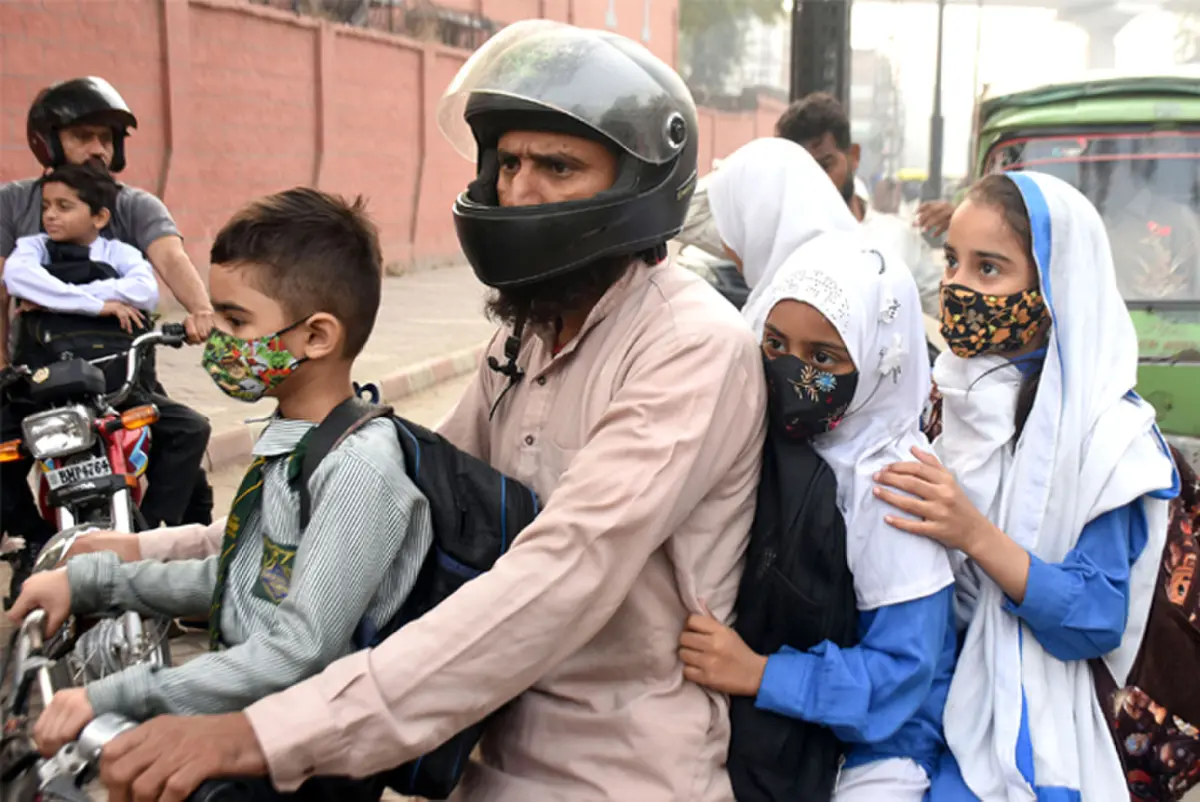
LAHORE: Lahore continued to remain the world’s most polluted city on Thursday as hazardous air quality persisted across the city and rest of the province.
The provincial capital recorded an Air Quality Index (AQI) of 394 during the 5-6pm period, despite the government’s claims of improvement and intensified enforcement against pollution sources.
According to IQAir’s live global major city ranking for 5pm to 6pm on Nov 12, Lahore recorded US AQI of 394, followed by Delhi at 218 and Ulaanbaatar at 188.
A separate IQAir city ranking showed Jhang Sadar recording an AQI of 579, followed by Raiwind at 437, Lahore at 394, Kahna Nau at 360 and Multan at 306. Sialkot recorded 261, Gujranwala 225, Faisalabad 176, Jhelum 170 and Rawalpindi 159.
Under the US AQI classification, readings of 301 and above fall in the hazardous category, while readings between 201 and 300 are classified as very unhealthy.
Meanwhile, the Environment Protection Agency (EPA) reported a significant improvement in Lahore’s air quality ahead of Diwali, followed by a fresh deterioration after the festival. The EPA’s report, titled “Lahore Air Quality Review: Monitoring, Meteorology and Source Analysis”, covering November 1 to 10, said the daily AQI declined from 422 on Nov 2 to 272 on Nov 7, a reduction of 36pc. PM2.5 concentrations fell by 43pc and PM10 levels by 33pc during the same period.
However, pollution levels subsequently increased. The agency recorded an AQI of 364 on Nov 9, 20pc higher than the average recorded on Diwali day, Nov 8, which stood at 303.
The EPA attributed the increase primarily to easterly winds carrying polluted air from Indian Punjab towards Lahore. Its monitoring data showed that pollution levels first increased at the Wagah border station, with other monitoring stations in the city recording peak levels around six hours later.
The agency also cited unfavourable weather conditions, including a 40pc reduction in average wind speed and a 44pc decline in atmospheric ventilation capacity compared with the corresponding period last year. Lahore received no rainfall during Nov 1–10, restricting the dispersion of pollutants.
The average AQI for the first 10 days of November stood at 334, compared with 280 during the corresponding period last year, marking a 19pc increase.
Despite attributing part of the deterioration to pollution transported from across the border, the EPA’s own emissions inventory identifies local sources as a major contributor to Lahore’s pollution. It attributes 83pc of the city’s emissions to transport, nine per cent to industry and eight per cent to other sources.
The assessment also documents the government’s enforcement measures with the department conducting 128,237 inspections of brick kilns and industrial units across Punjab from Jan 1 to Nov 10. It imposed fines amounting to Rs414.5 million for violations involving kilns, industries and plastic-related activities, and sealed 6,198 premises.
Agricultural residue burning, another major source of seasonal air pollution, also remained under surveillance. According to Suparco satellite monitoring data cited in the report, 643 fire anomalies were detected in Pakistani Punjab by Nov 10, compared with 817 during the same period last year, showing a 21pc reduction. The estimated burnt area also declined by 36pc.
The EPA said 593 of the 643 detected fire anomalies had been attended to in the field, with 80 FIRs registered and fines of Rs3.08m imposed during the current smog season.
Other measures included mechanical sweeping over 11,974 kilometres of roads and water sprinkling over 1,818 kilometres by the Lahore Waste Management Company between Nov 1 and 10.
The Punjab Safe Cities Authority cameras also detected 13,617 violations involving uncovered construction material and 10,266 cases involving smoke-emitting vehicles between September 1 and November 10.
The report further stated that 12 anti-smog guns were operating at different locations in Lahore, while 61 suction hoods had been installed on Nov 10 to control emissions from commercial kitchens.
Published in Dawn, November 13th, 2026