0
0
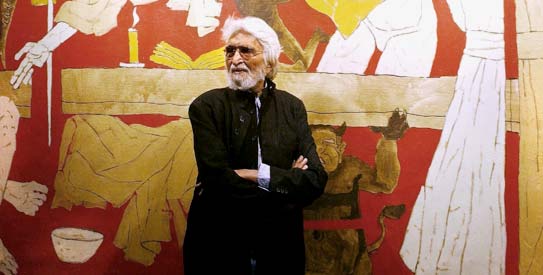
MUMBAI: India's most famous modern artist M.F. Husain, who left the country in 2006 due to threats from Hindu extremists, died on Thursday in London, media reports said citing family members.
Husain, who was aged 95 and known as the “Picasso of India”, died at the Royal Brompton hospital in London, the Press Trust of India news agency said.
Indian television news channels reported he had suffered a heart attack and lung failure.
“India didn't have the privilege of seeing him in his last moments, that is a huge loss for this country,” Jitish Kallat, one of India's leading young artists, told NDTV news.
“As an artist several decades younger than him, I feel like a part of the canopy has blown off,” he said. “He evolved the public notion of what it meant to be an artist in this country.”
Maqbool Fida Husain, formerly based in Mumbai, was accused by Hindu hardliners of insulting their faith for portraying goddesses in the nude in some of his paintings — a depiction that he said symbolised purity.
Following threats by a radical Hindu group that offered a reward of millions of dollars for his death and thousands of legal cases filed against him for offending “Hindu sentiment,” he moved to Qatar in 2006 and accepted Qatari citizenship in 2010.
In 2008, Husain's works were attacked by members of the Bajrang Dal, a right-wing Hindu group, at an event in New Delhi — the same year that one of his paintings, influenced by a Hindu epic, fetched $1.6 million at Christie's South Asian Modern and Contemporary Art sale.
When he accepted Qatari citizenship last year, Husain said he had chosen to go into exile to be able to paint in peace instead of living in fear over death threats from Hindu fanatics.
“At the age of 40, I would have fought them tooth and nail but I just wanted to concentrate only on my work. I don't want any disturbances,” he said in an interview.
He said he was content to be a non-resident Indian and that he had no qualms about losing his nationality, as India does not allow dual citizenship.
“What's citizenship? It's just a piece of paper,” he said. “Wherever I find love I will accept it.
“Ninety-nine per cent of Indian people loved me and they still love me. I'm an Indian-origin painter. I will remain so to my last breath,” he said.
The Indian government had recently tried to draw him back to his native country, with home secretary G.K. Pillai pledging to provide adequate security to protect him.