The talkative dead

| 17th January, 2013
54
Send to Kindle

290-quetta-hazara-protests-afpMy relationship with the people I come across on any given day is decided by their numbers. When they are individuals or small groups I feel responsible for them and try to protect them. When they are a mob, I feel responsible for my family and try to protect myself from them.

I am a policeman. Not one of your obese, maskeen police wallahs but a university graduate, police academy trained, one star assistant sub inspector. I like working from the office and with individuals and the local community; and crowd control is all I’ve been assigned in the past couple of years. Islamabad is not a big and crowded metro. Public gatherings here are few and far between, and tend to be of more manageable size and temperament than anywhere else in Pakistan. But the violent ones can get very messy. During and since Lal Masjid, the Islamabad Capital Territory Police has been attacked and overrun by seminary students, lawyers, goons of a local MNA, Namoos-e-Risalat mobs … and on a frequent basis, terrorist groups.

My mother and wife agree on only one thing, that I should not take my job too seriously to risk my life. That no medal is worth dying for and no insult is too hurtful if it saves your life. In my brief career, I have never been seriously under threat – as a law enforcer, as an individual citizen, as a Sunni Muslim, or as a Potohari – though, I have had colleagues and work buddies blown into bits that had to be gathered from the ground and plucked from trees and car shells. I have had colleagues kidnapped, tortured, and executed. I don’t really see them as heroes; quite the opposite. For the most part, they were unfortunate to be at the wrong place at the wrong time, and in some cases, for the wrong reason. They make up one statistic that I do not wish to become part of.

For an average-sized demonstration – one in which all the participants and their placards fit into the camera frame – I get to lead a team of six to 10 constables. The protesters are always well to do professionals – lawyers, doctors, journalists, but mostly the civil society which is what the NGO types call themselves. They all feel aggrieved, blame each other, the government and police, and sometimes resort to violence to protest against violence. I don’t judge anyone. I don’t support an ideology and I don’t oppose an ideology. I am not even interested enough to have an opinion of the issue that gets people out in the protest. My job is to ensure that the assembly stays out of trouble and ends peacefully, and that my team finishes its shift without hurting and getting hurt.

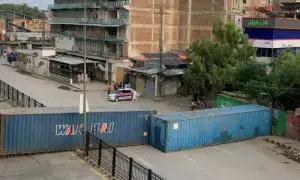
This assignment seemed fairly routine which is why I was caught unawares at the end of it. A couple of hundred people were gathered outside a Super Market last Sunday evening to protest against the killing of Hazaras in Quetta. They’d been there all through the previous afternoon and night. There were the usual faces – the so-called civil society (does that imply the rest of the society is uncivil?) that included a number of non-Muslims – but many were strangers to the city’s protest culture. They were Hazaras. I have never seen them becoming part of any demonstration. I could, however, understand why they’d come out – men, women and children – this time. Their dead were urging them to.

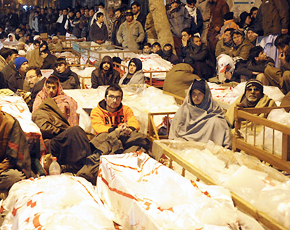
Hazaras are being killed like birds in a cage. They cannot run, they cannot hide, they cannot defend themselves. I saw a poster of one of the victims of the Quetta tragedy and remembered this young man Irfan Khudi as a regular participant of civil society demonstrations. I looked at a Hazara child and wondered if he will live to be a man and die a natural death in old age. Or will he become another talkative dead body like the 86 who were speaking non-stop for the past three days, from their coffins placed on Alamdar Road in Quetta? Why are they talking and why won’t they let their families bury them? Why was I thinking? I am only required to watch, anticipate, and act, I reminded myself.

But there was nothing to do. Except for a brief encounter with students from a nearby madrassah yesterday, who took offence at anti Lashker-e-Jhangvi slogans, the marathon event had been largely uneventful and sober. Protesters were sitting on neatly laid rows of darris, listening to speeches from anyone who wished to say something. Occasionally, a speaker from Quetta or an overseas gathering would be heard through phone line. Apparently, similar protests were being held everywhere Pakistanis live. There weren’t many Hazaras among the speakers though. They sat motionless, or served the protesters food and tea with a hospitable smile, and spoke shyly and politely; too politely for a people being hounded relentlessly and murdered systematically. It must be the reticence and compulsive politeness of the whole community that was infuriating the dead. Their decomposing bodies were yelling for the living Hazaras to speak up for their right to live. The effort pushed the remaining blood in their bodies to spill out of their pores, and the family mourners had to change their white cotton shrouds every few hours.

I thought of my village in Potohar and tried to imagine the reaction of people there if a 100 of them were murdered in one day. There will be mayhem. At least 200 of our enemies will have to pay a price with their blood. If we can’t punish them ourselves we’ll push the police, army, courts, and governments to do that. If that fails men will sell their fields and women their jewellery to buy weapons or hire a terrorist gang, but we will be avenged. And here, are these Hazaras who’ve lost close to a thousand people in a year and are being so apologetic for having to block a road, for protesters spending a freezing cold night under the sky, for not providing children and women with warm and comfortable bedding … ‘Oh poor Hazaras, poor poor Hazaras’ cried the dead and choked on their own words.

No one cares for the Hazara, someone said in a small group of protesters standing close to me, having a smoking break. Others joined in:

“The chief minister is still abroad.”

As if he could be of any help if he was here. The last time Hazaras were killed he said that all he can do is send them a truckload of tissue rolls to wipe their tears.

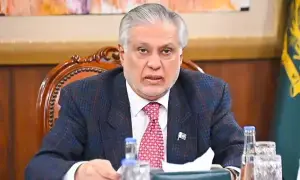
The prime minister says he’ll meet with Hazara community leaders in a week’s time and will listen to their demands.

Forget the governments, even the media does not care. Tomorrow’s long march is more important for them.

The BBC Urdu Service says the most popular story on its website is about adult filmmakers in Hollywood challenging the legislation that requires actors to use condoms.

Suddenly, the Alamdar dead’s voice rose as one and addressed me directly. I could hear it clearly. It said what started with the Ahmadis is not going to end with the Shias. When all Shias are killed or forced out of Pakistan, or tamed into submission, then what? Who is next? It could be you, or your sons and daughters. If you want to live, you’ll have to speak up for the right of others to live. Sit down with these protesters or run away from this country as fast as you can.

And that was when it happened. I never mix work with emotions. I always control crowds and never become part of one. And I never, ever listen to the dead … I took off my service beret, wrapped a chador around my uniform and name plate, and sat down on the darri among my own.


Masud Alam is an Islamabad-based writer, columnist and journalism trainer. He can be reached at masudalam@yahoo.com


The views expressed by this blogger and in the following reader comments do not necessarily reflect the views and policies of the Dawn Media Group.

COMMENTS

  1. No body raised voice for poor ahmedis when they butchered in Lahore couple of years back and the only Governer who had soft corner was killed. Now Hazara’s I can understand why the chief Minister was not interested as he has to Live. The only answer seems to be is to give the masses of basic education of religion and also how to live as a social animal.

  2. I appreciate the clear mind and heart of this writer. I am sure many would agree with him in this jungle of humans.

  3. Bravo, beautifuly written. What a shame, all these satanic acts of murder, intolerance, hatered and ethnic cleansing are being perpetrated on the pretense of being religious. What a shame.

  4. By the way are you really in police force, your writing skills are too good ??

  5. A VERY WELL WRITTEN N INSPIRING , HATTS OF 2 U WRITER

  6. - To all those who think this is some kind of ‘war’ (proxy war b/w Iran and Saudi): it its NOT a war. It is a one-sided thrashing where the victims occassionally bite back (and in case of hazara’s they NEVER have!). A minority *cannot* wage a war against a majority, so please stop calling it a war!

    - ..And to those who think it started with Ahmadis: think again, it was in 1932 that SAUDIS took over Hijaz. One of the first things they destroyed were the relics of the Prophet(saw) and his family, esp. of the Shia Imams (of not one but FOUR Shia Imams!). So the fate of Shias in the region was already sealed in the ’30s. What’s happening today in Pakistan was bound to happen sooner or later, given the clout that the petro-dollar have garnered over the decades (coupled with the rise of wahabism!)

  7. Excellent article. What has to be controlled is the hate being spread under the guise of religion through the madrassa system. This fact is recognised but every government including the military ones have avoided doing anything about it because of ineptitude or complicity………..the result is staring us in the face.

  8. My name is razia batool, a student and by birth a HAZARA. I really feel so good when I see people related to other communities support and raise voice for us. I’m really glad to the writer individually and and to dawn.com as well because I have been reading similar articles in this website, which is I think the only website which is not administered by any HAZARA guy but still we can find this kind of material. I myself, being in contact with other citizens of this country while being in college and university have respect for their beliefs , language, culture and religion. Rather we appreciate and love unity in diversity. So why can’t we have the same right to be among others and be loved by others? During the past years we are being killed and due to the same reason others see us with an eye full of hatred or sometimes mercy, because in one way or another the current scenarios are effecting the people’s psychic. Because If it is me or you, we might also think that of course there must be something wrong with these people that are being killed constantly.
    As By now people might have known about us that we are truly peace loving people, love education and development and still love this country, though we are hurt so much here. We want to have our contribution in the development of this country and serve the motherland only if we are not forced to vacant the country as there are some groups who want to clean up this country from our existence . We love and respect every sect and people related to them, because we are still Muslim, all of us.
    It is only Allah who has the right to give or take life, so why others are trying to have it?

    PEACE

  9. good article….but it did not started with Ahmadis. It started with Hindus and Sikhs way back in 1946..remember?

  10. A really excellent piece.

    However, from the outset you mentioned you are a “Sunni Muslim” and I guess out of fear or appeasing the so and so, proclaiming this identity has become vital for writers and TV anchors. I wonder what has brought us to this level of identity recognition and fear? I can imagine soon enough people would be seen walking around wearing Tee-shirts and hats in Pakistan proclaiming “I am a Sunni Muslim” to be socially accepted and avoid being persecuted or murdered in the name of religion.

  11. A Hazara from Alamdar Road (currently in the Diaspora) … a very powerful and moving article. While we (the Hazaras) do not have any expectation from those in the power corridors in Pakistan, believe me that our entire nation of 9-million (scattered around the world) has been moved by the love and support we have received from citizens of Pakistan and humanity everywhere.

    Btw, we are not just Shia. Hazaras are mainly Shia, but also have a sizable Sunni and Ismaili populations as well (especially in Afghanistan). But religious, national, boundaries are all meaningless. Humanity is at a higher tier and must supersede everything else.

  12. Very nice article except the comment, “no medal is worth dying for and no insult is too hurtful if it saves your life” I believe that as Pakistanis we have lost the pride that comes as part of being a free nation. Even after our so called freedom, we are still ruled by others and thus a poiceman is now saying that no medal is worth dying for even if it means the country is thankful to you for doing your job and dying in the process.

    • Agree: a policeman need not die just for the sake of a medal but he must not hesitate to sacrifice for his country, if the need arises, regardless of whether it leads to a medal. Overall, very well written article.

  13. wow! what an article. (why can’t my country’s writers match this level)?

  14. Two hadiths of the prophet:
    (1) Muslims will be divided into 73 sects of which only one will be on the correct path. NOTE: He did not label the other 72 not on right path as kafirs but as Muslims.

    (2) a MUSLIM is one from whose hands and tongue, ALL Muslims feel safe, and NO Muslim fears harm.

    Think about it my brothers and sisters. While only a minority amongst us are (sunni) extremists killing, and blowing Muslims to bits and pieces, a clear majority of us are guilty of harming the ummat with our tongues. We have become like the Fox News anchors. We take things out of context from their scholar’s texts, twist it and then use that to prove our point about the other being a kafir…. blissfully ignorant of the kufr inside us.

  15. Your writing is certainly not what I would expect from someone working in the police force. Very well written. As long as people in the 21st century revolve their complete life around religion, this is what is going to happen.
    >Name one good thing that can be done in the name of religion and cannot be done by a non-religious person. (I would say none)
    >Name one bad thing that can be done in the name of religion that would not otherwise be done.

    I hope you get the point.

  16. excellent article, it is the narrow vision of the majority in the country which is continuing the killer approach. at the start of the independence the hindus were the targets then came the turn of Ahmedia community then kadianis and some more and now shias .once the vision gets narrow it goes on becomming narrower and narrower. it has to stop for the country to acheive the Founder’s vision.