Pezeshkian says Iran will not surrender after Trump's annihilation threat
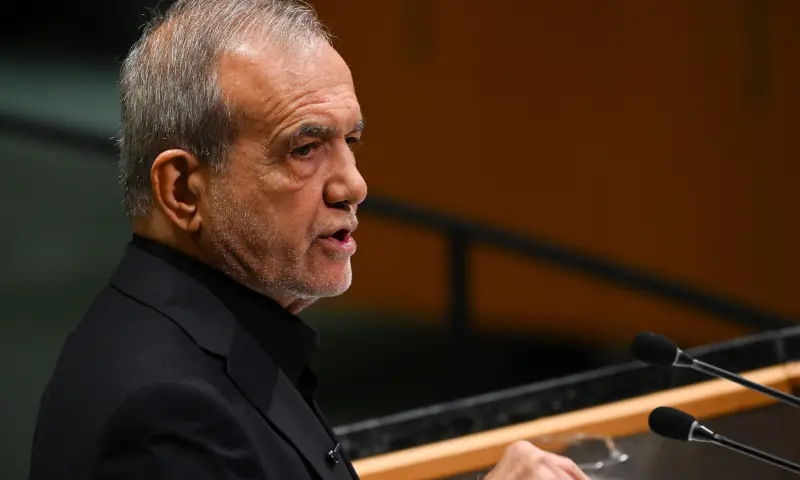
Iranian President Masoud Pezeshkian said in a speech at the United Nations on Wednesday that Tehran would never surrender to the United States but still believes in diplomacy, a day after US President Donald Trump used the same forum to threaten to “annihilate” Iran.
The duelling speeches at the annual UN General Assembly in New York bookended the first shuttle talks between the US and Iran for months, which appeared to have yielded no concessions in the public stance of either side towards ending the Middle East war.
In his speech, Pezeshkian defended Iran’s military actions as defensive, and insisted Iran was not seeking nuclear weapons.
The president struck a defiant tone speaking at the UN for the first time since Washington and Israel launched an all-out war on his country, vowing Tehran would never “bend at the knee”.
Pezeshkian accused Washington of “terrorism” for assassinating former supreme leader Ayatollah Ali Khamenei at the start of the war. He held up a photograph of the dead leader, before insisting Tehran had never started a war.
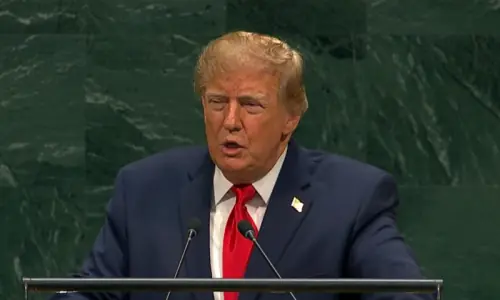
On Tuesday, Trump had told the UN he was weighing whether to “annihilate” Iran, but went on to hail renewed talks between Tehran and Washington’s negotiators.
Pezeshkian made no reference to the talks to resolve the stalled war in his steely speech.
“(Trump) must know that the resistance of the Iranian people will only increase in the face of sanctions, increased pressure, increased bullying. We will never bow our head or bend at the knee,” he said.
Pezeshkian insisted that Tehran would not allow the Strait of Hormuz, which it has been intermittently blockaded since the start of the war causing global energy prices to spike, to be used for aggression against his country.
“We cannot let some have free access and bolster their interests from the waterway, while at the same time using that waterway to impose their aggression upon us,” he said.
Soaring fuel prices threaten to cost Trump’s Republicans their control of Congress in November’s midterms.
Pezeshkian’s attendance at the UN’s signature diplomatic event, in the heart of Manhattan, had been in doubt as it was unclear if the United States would issue a visa.
Ultimately Washington granted the permit, but denied visas to several members of Pezeshkian’s entourage.
Indirect contact
The annual UN gathering in New York provided the occasion on Tuesday for Iranian and US officials to hold their first known indirect talks since a ceasefire collapsed in July, with Iran’s Foreign Minister Abbas Araghchi and US envoys Steve Witkoff and Jared Kushner communicating through mediators on the sidelines.
“Steve and Jared had a very productive meeting today with mediators of Iran,” Trump said on Tuesday after his own speech.
“I think there’s a lot of momentum for them to make a deal. It’s what we’re hearing from everybody.”
Iranian Foreign Ministry spokesperson Esmail Baqaei said Tehran had engaged with Washington through a Qatari mediator and conveyed conditions, including an end to the war on all fronts and a halt to US “acts of aggression”.
Some Iranian state media initially reported that Araghchi and Witkoff had met, but Iranian officials clarified to Reuters that it was not face-to-face.
The diplomatic contact in New York caused a backlash in Iranian media associated with hardliners.
An opinion piece run by the semi-official Tasnim news agency, associated with the Revolutionary Guards, said Araghchi was wrong to have contacts with Witkoff and Kushner, “a major gift to Trump”, as Iran had already conveyed its terms.
Iranian sources told Reuters the delegation had been ordered not to meet the Americans face-to-face by the Supreme National Security Council, a body that includes figures selected by Ayatollah Mojtaba Khamenei, the supreme leader.