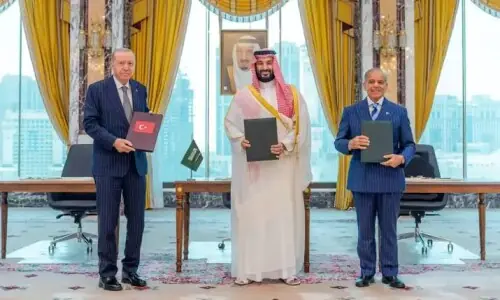
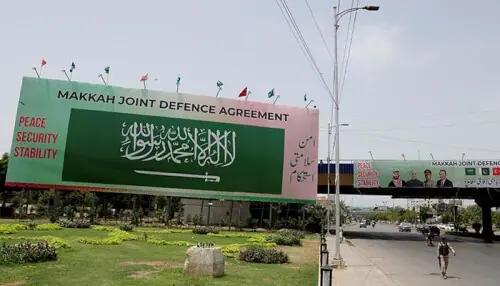
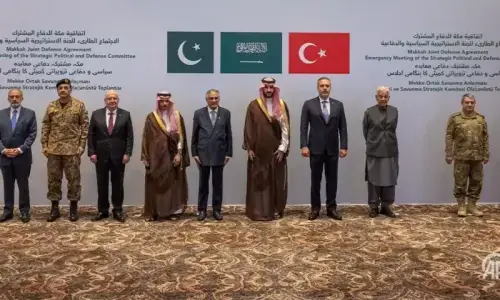
THERE had been much speculation about what exactly the trilateral Makkah Joint Defence Agreement entails, other than general commitments about the collective defence of Pakistan, Saudi Arabia, and Turkiye.
But with the release of the text of the 16-article agreement, there is now some clarity about its objectives. While Article 2 says that an “externally originating armed attack” on any of the signatories will be considered an attack on all, triggering the right of self-defence under the UN Charter, the agreement is silent on offensive action.
This should settle questions about the extent of involvement of the pact allies in the ongoing Saudi-Houthi war, and any future engagement. That it is a purely defensive arrangement was also echoed by the Turkish foreign minister.
He stressed it was not an “offensive agreement”, and ruled out sending his country’s troops to a foreign theatre. Other salient features of the pact include joint defence production, intelligence sharing and the interoperability of forces. Such clarity is welcome. While the defence of Saudi Arabia is important, Pakistan, Turkiye, and other regional states should continue efforts to find a negotiated solution to the Yemen conflict — both between the Saudis and Houthis and within Yemen.
In a related development, Pakistan’s chief of defence forces was in Tehran on Tuesday to try and prevent further escalation on the war front. The message from Tehran is that the US should accept Iran’s seven-point proposal if talks are to restart. A key Iranian demand is a ceasefire on all fronts, the end of the American blockade, lifting of sanctions, and the release of the Islamic Republic’s funds. However, despite the efforts of Pakistan and others, there are troubling noises coming from Washington and Tel Aviv.
The abrasive US war secretary — who is no proponent of peace and dialogue — was recently in Israel, while the Israeli prime minister, who will be fighting for his political survival in next week’s elections, has said he and President Donald Trump need to ‘eliminate’ the “Iranian regime”.
Even the sincerest effort to bring peace to the Gulf, Yemen, and the wider Middle East will come to naught if the US and Israel continue with their provocative behaviour. A strike on Iran after the Israeli and US elections would be a massive blunder, and if there are any mature advisers left in Washington, they should talk the US president out of making any such move, besides warning Tel Aviv against such arrogant action. Iran may be under pressure, but as the past several months have shown, it has the capacity to withstand considerable pain inflicted on it by the US and Israel. Fresh aggression can kick off a firestorm that will be in no one’s control, hence it is best to abandon such reckless plans.
Published in Dawn, October 22nd, 2026